




TL;DR
Rigid, rules-based automation forces marketers to manually map every customer journey, leading to broken experiences and lost revenue when users deviate from the expected path. Netcore’s agentic marketing lifecycle replaces these “if-this-then-that” workflows with autonomous AI systems that continuously observe behavior, decide the next-best action, and execute across omnichannel touchpoints. By shifting from manual execution to intelligent autonomy, operations leaders can finally scale true 1:1 personalization and hold their martech stack accountable for measurable ROI.
Rules-based automation is failing marketing operations leaders because it demands that you predict every possible path a customer might take before they take it. We built Netcore’s agentic marketing architecture to replace these brittle, manual workflows with autonomous systems that continuously observe, decide, and act in real-time. This is not a superficial upgrade to generate faster email copy; it is a fundamental, structural shift that holds marketing technology accountable for measurable revenue outcomes.
What is the Agentic Marketing Lifecycle?
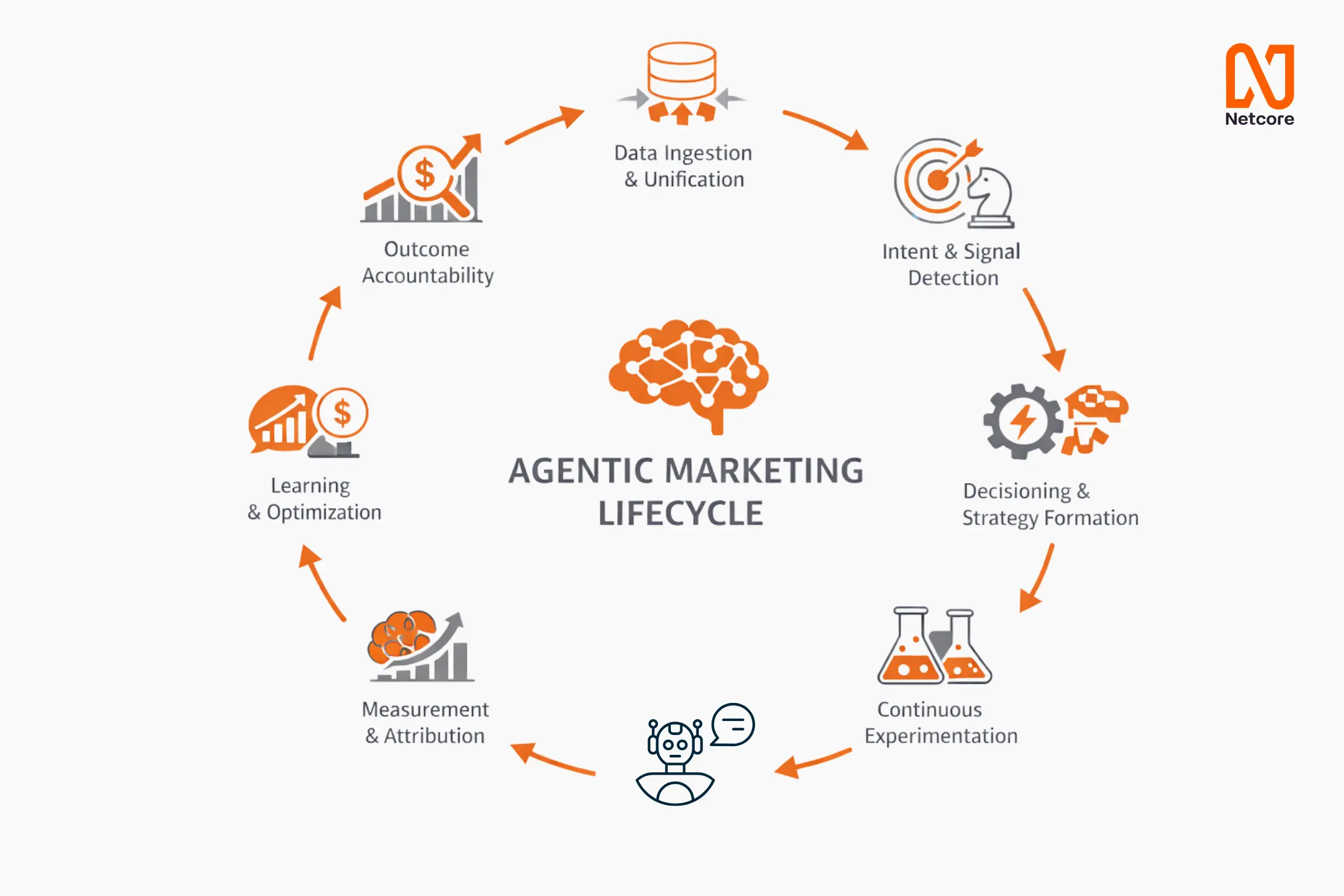
The agentic marketing lifecycle is an autonomous “Observe-Decide-Act” loop where AI continuously ingests real-time customer data, predicts the next-best action without manual rules, and executes campaigns across omnichannel touchpoints. It replaces static journey mapping with dynamic, autonomous decision-making to drive measurable ROI and direct business outcomes.
For the past decade, growth architects have been trapped in a paradigm of execution over intelligence. You buy a platform, you ingest customer data, and then your team spends countless hours building complex journey maps to trigger messages based on fixed conditions. The problem is that human behavior is not linear.
The agentic marketing lifecycle fundamentally inverts this model. Instead of humans defining the rules and software executing them, the software dynamically defines the path based on a target outcome, and the human provides the strategic guardrails. At Netcore, we view this lifecycle not as a theoretical concept, but as the core engine required to drive accountability in modern marketing stacks.
Why are Rules-based Automation Costing you Revenue?
The fundamental flaw in legacy marketing automation is that it assumes you can map out human intent on a digital whiteboard. You build a welcome series, an abandoned cart flow, and a reactivation sequence. But the moment a customer steps outside of those predefined boxes, perhaps they abandon a cart on mobile but browse a related category on desktop, the rigid rules break. The customer receives a generic batch-and-blast email or, worse, a conflicting sequence of messages across different channels.
This “if-this-then-that” architecture actively costs you revenue because it cannot scale personalization. As marketing stacks expand, martech sprawl creates disconnected tools and data silos, leaving you without a single source of truth. Attempting to manually update journey branches across email, SMS, push, and WhatsApp requires an army of operators and still results in an inferior customer experience.
As enterprise workflows become more complex, manual segmentation simply cannot keep up. Industry research confirms this structural bottleneck; in fact, agentic systems are required to scale personalization across enterprise workflows. When you rely on marketers to guess the next best action rather than allowing autonomous agents to calculate it mathematically, you sacrifice conversion rates, customer lifetime value (LTV), and ultimately, your return on investment.
How Does the Agentic Marketing Lifecycle Work?
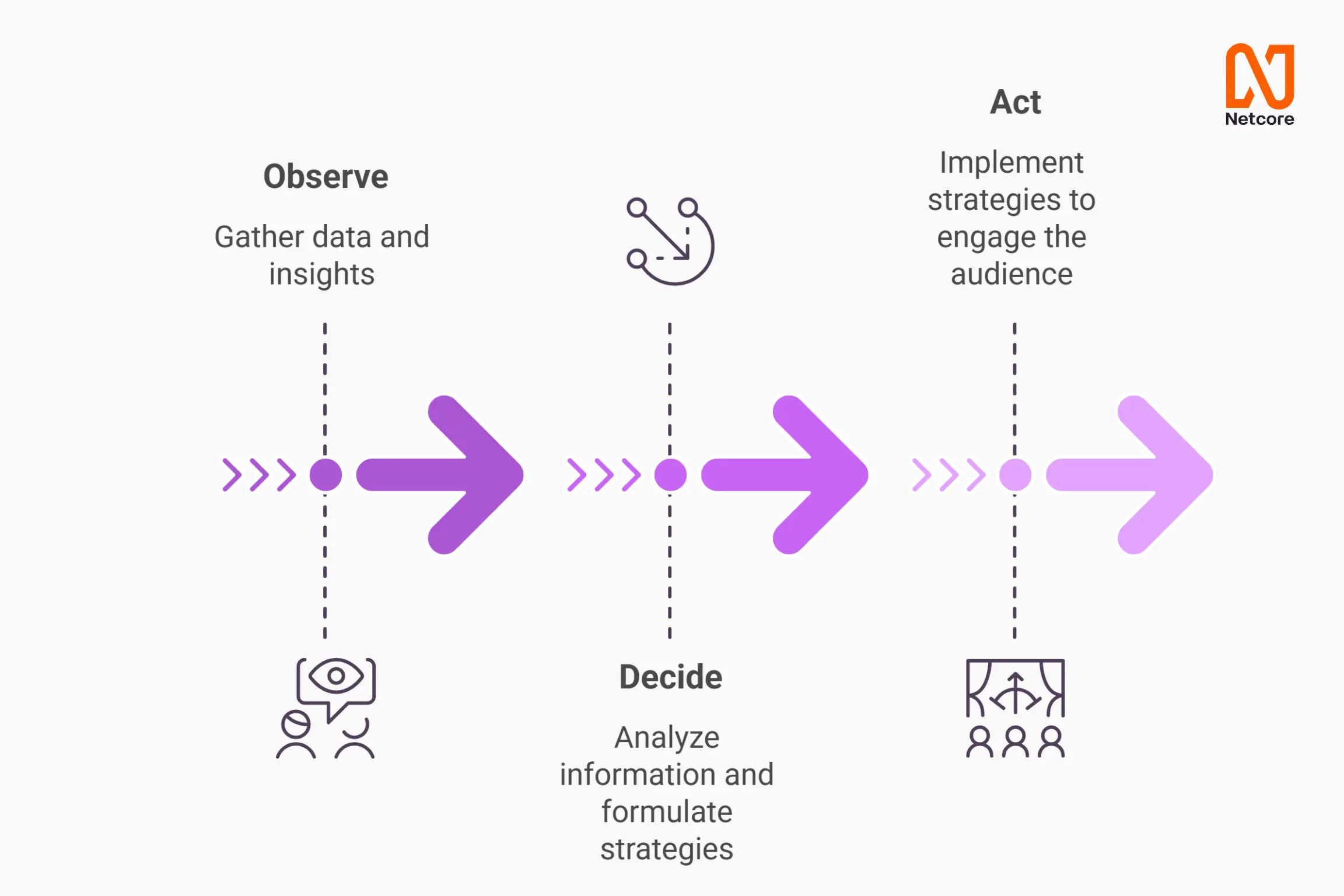
To move beyond surface-level automation, your stack must transition to a dynamic, autonomous state. We engineer our platform around a specific, continuous loop that guarantees intelligence dictates execution.
Here is how the agentic marketing lifecycle functions in a production environment:
- Observe: Continuous ingestion of behavioral signals, transaction history, and real-time data tracking without manual intervention or batch delays.
- Decide: Autonomous decision-making using predictive AI models to determine the exact next-best action, channel, and timing for each individual user.
- Act: Omnichannel execution and real-time optimization to deliver the experience seamlessly, adjusting instantly based on the user’s response.
At Netcore, our core philosophy is that agentic marketing operates on a continuous loop of observing, deciding, and acting in real-time. It is a persistent cycle that grows smarter and more accountable with every interaction.
Stage 1: Observe (Continuous Data Ingestion & Behavioral Tracking)
The foundation of any agentic system is its ability to see the customer clearly. Legacy systems rely on batch uploads or delayed syncs, meaning you are always marketing to who the customer was yesterday.
In the Observe stage, autonomous agents continuously monitor millions of data points across your digital properties. They track active sessions, dwell times, product affinities, historical purchases, and cross-channel engagement. This ingestion happens in real-time, creating an always-updated Customer Data Platform (CDP) profile. Crucially, the system isn’t just storing this data; it is actively looking for anomalies, patterns, and signals of intent that a human operator would miss.
Stage 2: Decide (Autonomous Decision-Making & Next-Best-Action)
Observation without action is just reporting. The Decide stage is where the true architectural shift occurs. In a legacy stack, a marketer looks at the observed data and builds a segment. In an agentic stack, the AI autonomously calculates the highest-probability path to conversion.
Our agentic marketing evaluates thousands of potential permutations for a single user in milliseconds. It answers complex questions: Should this user receive an SMS or an email? Should we offer a 10% discount, or are they likely to convert at full price? Is it better to send the message at 9:00 AM or 2:15 PM based on their historical open patterns? The system defines the next-best action mathematically, optimizing for the business outcome you configured, whether that is maximizing immediate revenue, protecting margins, or driving retention.
Stage 3: Act (Omnichannel Execution & Real-Time Optimization)
Once the decision is made, the agentic system executes the campaign across the most effective channels seamlessly. Customers do not see channels; they see brands. Therefore, the Act stage must be fluid across email, SMS, WhatsApp, push notifications, and in-app messaging.
But execution is only half of the Act stage. The system immediately measures the user’s reaction to the message and feeds that data back into the Observe layer. If the user ignores the push notification, the agentic loop registers the failure, autonomously recalibrates, and decides the next step, perhaps suppressing further communication for 48 hours to prevent fatigue. This real-time optimization ensures that your martech stack is held accountable for every interaction.
What are Real-world Examples of Agentic AI in Marketing?
Theoretical frameworks only matter if they drive business outcomes. At Netcore, we focus on practical agentic marketing use cases across personalization, optimization, speed-to-market, efficiency, scalability, and governance. We have deployed these systems successfully across verticals, including ecommerce, BFSI, travel, subscriptions, and quick commerce. Check out some agentic marketing use cases.
Here is how agentic marketing translates from a concept into a measurable pipeline and revenue.
Use Case 1: Dynamic segmentation
Static lists decay the moment you export them. Legacy marketing relies on defining segments like “Users who opened an email in the last 30 days but didn’t purchase.”
Agentic AI eliminates manual list building. Instead, it deploys autonomous agents that dynamically move users in and out of micro-segments based on real-time behavior. We see agentic marketing is actively reshaping campaign planning and segmentation by shifting the focus from historical filters to predictive intent.
Use Case 2: Autonomous customer journey orchestration
Building a 50-node journey map in a legacy automation canvas is an exercise in futility.
With agentic workflow integration, growth architects set the destination, such as “drive a repeat purchase within 14 days”, and the agentic system builds the path dynamically for each user. For a highly engaged user, the agent might send a single, targeted in-app message. For a dormant user, it might orchestrate a cross-channel sequence spanning email and SMS over three days. The system autonomously adapts the journey as the user interacts, completely replacing static journey builder canvases and significantly accelerating time-to-value.
Use Case 3: Real-time personalization in ecommerce
In ecommerce and quick commerce, intent changes by the second. If a user is browsing winter coats on your app, an email sent two hours later featuring summer clearance items is worse than irrelevant; it trains the customer to ignore you.
Our agentic marketing monitors the live session in the Observe stage, identifies the exact product affinity, and autonomously updates the product recommendation blocks in all outgoing communications across all channels. If the user buys the coat in the app, the agent immediately removes the item from their retargeting ads and subsequent emails, replacing it with complementary accessories.
Use Case 4: Predictive churn prevention in subscriptions
Subscription businesses and BFSI organizations live and die by retention. Rules-based systems try to prevent churn by sending an email exactly three days before a renewal date.
AI agent looks deeper. It observes subtle behavioral shifts, a drop in daily login frequency, a decrease in feature utilization, or changes in transactional velocity. The AI autonomously flags the account for churn risk long before the renewal window and decides the appropriate intervention. It might trigger a personalized outreach from a customer success manager or automatically apply a tailored discount to their next billing cycle, measuring the exact revenue saved through these autonomous actions.
Use Case 5: Dynamic send-time and channel optimization
Batching messages at 10:00 AM on a Tuesday is an outdated practice that leaves money on the table.
Netcore’s agentic systems observe the historical engagement patterns of every individual user down to the minute. The Decide stage calculates the precise moment a user is most likely to be holding their phone and open an app. The Act stage then holds the message until that exact second, autonomously selecting the channel (e.g., WhatsApp vs. Push) with the highest historical conversion rate for that specific individual. This directly impacts top-line metrics without requiring any additional creative output.
Final Take
Agentic marketing isn’t just a feature upgrade or a smarter way to generate campaigns; it’s a fundamental shift from manually mapping journeys to deploying systems that think, decide, and act in real time. In this article, you’ve seen how the customer journey is evolving, from static, predefined paths to dynamic, continuously optimized experiences, and why adapting to this shift is critical to stay competitive.
If this has sparked new ideas on how your marketing should evolve, the next step is turning that inspiration into action. Ready to build an agentic lifecycle tailored to your business? Let’s create a strategy that works for you. Talk to us.