




If you’ve spent years or a decade in digital marketing, you know exactly what Monday mornings feel like.
You walk into the week with dashboards open and a hundred tabs in your browser. Campaign reports from Email, Paid, WhatsApp, CRM, all staring back at you. Numbers everywhere.
CTR looks fine. Conversions? Not so much. The pipeline is slightly off target. CPL is creeping up. A 2025–2026 body of research on marketing performance shows that slow or end‑of‑cycle analysis is a major reason campaigns fail, because teams only diagnose problems after the budget is spent and the window has closed.
And then comes the real pressure: “What happened?”
For years, my job was to have answers. Or at least something that sounded like one.

The Reality Behind the Reports & Dashboards
A 2026 Marketing Intelligence Report (Funnel and Ravn Research) finds that 72% of in‑house marketers and 55% of agency marketers feel overwhelmed by the amount of data they collect, and 86% of in‑house marketers cannot isolate the true drivers of performance.
A typical Monday for me used to look like this:
- Pull campaign data across channels
- Compare week-on-week performance
- Identify drop-offs in the funnel
- Build a narrative for leadership
And yet, despite all this effort, I was always slightly uncomfortable.
Because deep down, I knew:
- I could see the problem
- But I couldn’t fully explain it
- And I definitely couldn’t fix it fast enough
I’d say things like:
- “CTR dropped due to audience fatigue.”
- “Conversions might be impacted by landing page issues.”
- “We should test new creatives.”
But these were educated guesses, not confident decisions.
And that’s the hardest part of being a digital marketer. You’re expected to drive outcomes, not just report metrics.
The Frustration: Knowing Metrics ≠ Knowing What to Do
Over time, the gap became clearer. We were measuring everything:
- Clicks
- Impressions
- Leads
- Conversions
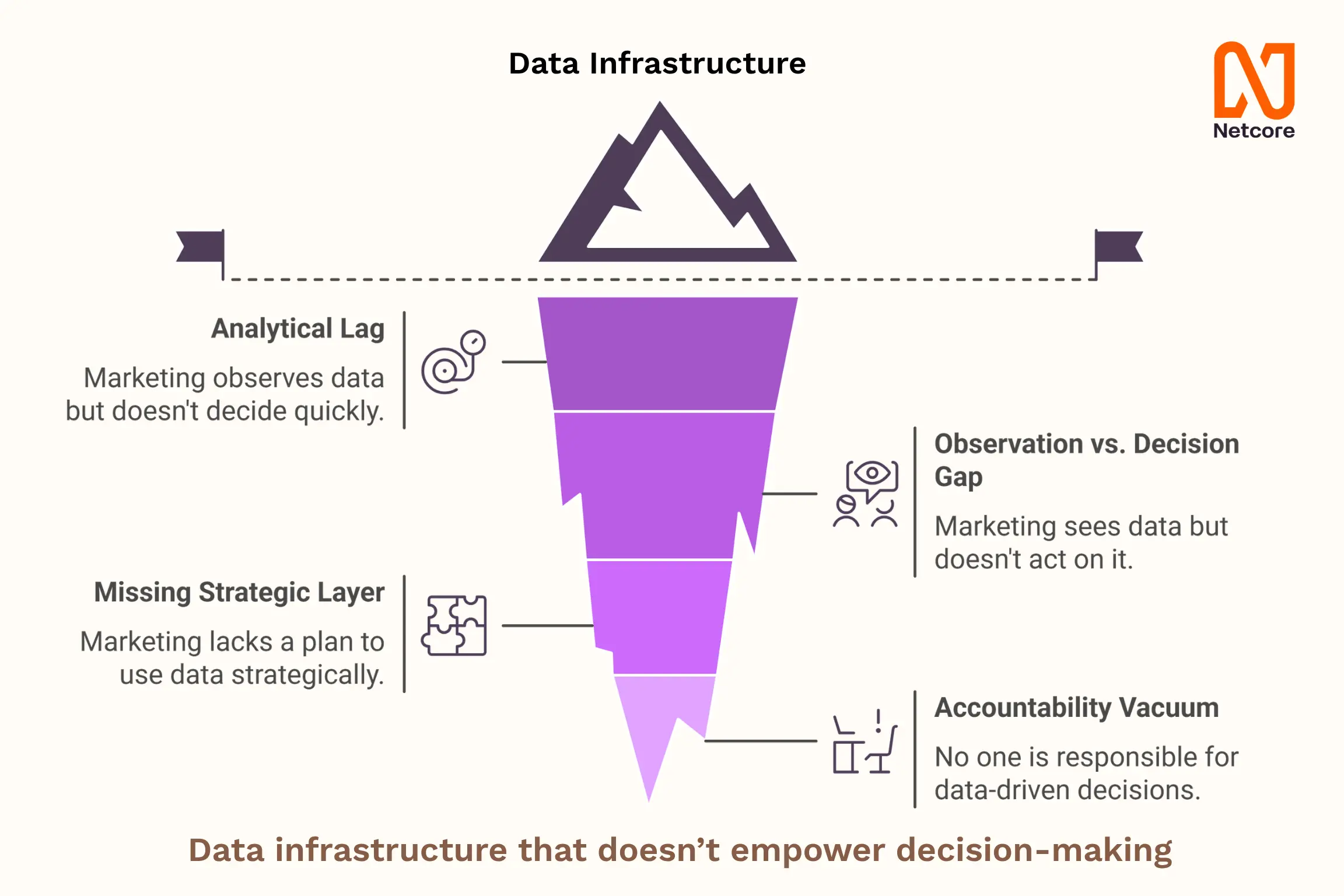
But we were still struggling with:
- Why did performance drop?
- Which exact lever should we pull next?
- Where are we losing actual revenue?
Our Monday meetings were efficient, but not effective.We spent most of our time explaining the past,
and very little time confidently shaping the future.
When the Questions Started Changing
Something shifted when we started pushing for deeper answers.
Instead of asking:
- “What happened last week?”
We started asking:
- “Why did this campaign underperform?”
- “Which segment is actually driving the pipeline?”
- “What should we change this week to improve results?”
That shift, from reporting to diagnosis, was a turning point.
But honestly, we didn’t have the tools to support that level of thinking.
Until we started using Insights Agent.
Insight Agent in Action
The word gets used loosely in martech. So let’s be precise. Decision intelligence, as embodied in Insights Agent, operates across three distinct dimensions that most tools don’t reach:
1. Diagnosis, not just detection
Most analytics tools detect anomalies. They tell you a metric moved. Insights Agent diagnoses why, tracing the failure back to its root cause across campaign, channel, audience, and funnel stage simultaneously.
Detection looks like: “Conversions dropped 34% week-over-week.”
Diagnosis: “Flash Sale email generated 15% CTR but only 1.2% conversion. Root cause: post-click landing page friction, load time above 4.2s, checkout steps increased from 3 to 5 after last week’s update.”
2. Revenue quantification, not just metric reporting
A metric without a dollar value is an observation. Insights Agent converts every diagnosis into a revenue impact figure, giving marketing leaders the language CFOs and CEOs actually respond to.
Metric report: “40,000 high-intent users were excluded from the campaign.”
Rethinking the change in segment change from a revenue point of view: “Those 40,000 users carried 3x average purchase intent. Estimated missed revenue: $100,000. Recovery window: still open.”
3. Recommended action, not just insight delivery
Insight without action is expensive decoration. The final layer of intelligence is prescriptive, a specific, executable next step that a team can act on today, not after further analysis.
Insight: “Non-converters from the Flash Sale email remain in-market.”
Action suggested by the Insight Agent, “Build segment: users who clicked the email but did not purchase within 48 hours. Launch ‘Forgot Something?’ retargeting on WhatsApp within 6 hours. Projected recovery: 12–18% of lapsed intent.”
This is the distinction that matters. Every martech tool in your stack delivers the first level. Very few reach the second. Almost none deliver the third consistently, at scale, without a team of analysts working through the weekend.
From campaign reviews to strategy sessions
The practical consequence of embedding Insights Agent into the marketing operating model is a fundamental change in how time gets spent. Not incrementally, structurally.
| Before with Manual Analysis | After with Insight Agent | |
|---|---|---|
| Hours spent pulling data before Monday meeting | → | Pre-built diagnostic brief, ready Sunday night |
| “Why did conversions drop?” (debate) | → | “Here’s the confirmed root cause, what do we fix first?” (decision) |
| Post-mortems completed 3–5 days after campaign ends | → | Automated post-mortem with revenue impact, ready within hours |
| Analysts building reports | → | Analysts running experiments and driving strategy |
| Revenue opportunities discovered in hindsight | → | Missed segments surfaced in real time, and recovery actions were launched immediately |
The meeting itself changes. When intelligence arrives pre-diagnosed, the agenda shifts from explaining the past to designing the next move. That is not a small operational improvement. It is a different kind of marketing function, one that operates at the speed of the business, not the speed of the analysis cycle.
Every CMO I speak with has invested heavily in their martech stack. And almost every one of them describes the same frustration: the tools are powerful, but the intelligence that connects them, the layer that synthesises across sources, diagnoses across dimensions, and recommends across channels, doesn’t exist.
That layer is not a dashboard. Dashboards show you the state of things. That layer is not an analytics platform. Analytics platforms help you investigate things. The missing layer is a strategic intelligence function that thinks alongside you, continuously, proactively, and with the commercial context to know what actually matters.
The martech stack gives marketing leaders the instruments. Insights Agent is the first tool that reads them together, and tells you what to play next.
The approximately 30% of queries that are now strategic or diagnostic in nature, rather than pure reporting, is the signal that marketing leaders already sense this gap. They are asking their tools to be smarter. They are pushing beyond “what happened” toward “what should we do.” The question is whether their tools are built to answer that.
Final Take
The future of marketing leadership is not about having more data. Every CMO reading this already has more data than their team can process. The future is about the quality of decisions that data enables, and the speed at which those decisions translate into action.
Insights Agent is not a reporting upgrade, it is a decision infrastructure upgrade. The difference between a marketing function that explains last week and one that shapes next week. Between a team that reacts to the business and one that drives it.
But here is the discipline that separates the teams that extract full value from those that don’t: they evaluate rigorously. They hold the intelligence accountable. They build a cadence, weekly accuracy checks, monthly quality reviews, quarterly effectiveness audits, that ensures the agent earns its place in the strategic process, not just the operational one.
Because intelligence that isn’t evaluated is just automation with good branding. And marketing leaders who have spent a career making high-stakes decisions know the difference between a tool that helps them think and one that just moves faster.
The strategic layer has been missing from your stack. Now it doesn’t have to be.