




There is a $500 billion hidden line item embedded in the global marketing economy. It is the Reacquisition Tax, the massive, recurring penalty brands pay to Google and Meta to buy back the attention of customers whose email addresses already sit dormant in their databases.
How do you lose a customer you already “own”? You lose them because traditional marketing technology is inherently stateless. To explain in layman’s terms, it remembers transactions but completely forgets context. When a customer’s attention begins to decay, flat databases and standard automation platforms cannot detect the nuance of their fatigue. The system keeps sending generic messages until the customer tunes out entirely, forcing the brand to reacquire them via expensive paid channels.
For Campaign Managers and CRM leaders currently navigating the Buyer’s Journey, this is a painful Market Reality. You are attempting to transition from manual campaign execution to intelligent, autonomous systems. You know that layering “AI features” over a flat Customer Data Platform (CDP) will only help you make generic mistakes faster. To stop paying the Reacquisition Tax, your architecture requires an entirely different foundation: organizational memory.
What are Context Graphs?
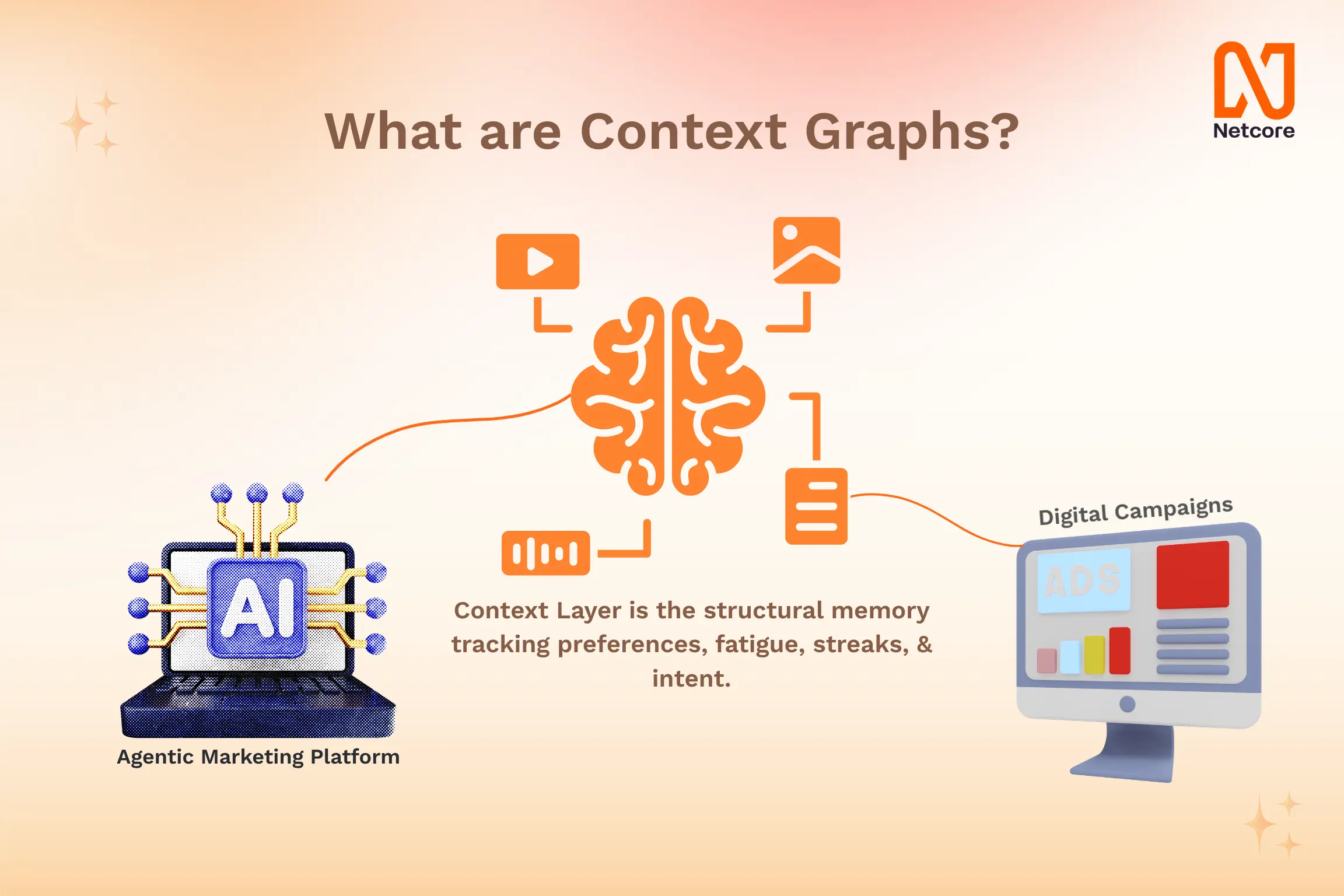
Context graphs provide the structural memory tracking preferences, fatigue, streaks, and intent that the Agentic marketing platform requires to make safe, autonomous decisions. Without this reasoning layer, AI cannot reliably own revenue KPIs. With it, brands transition from paying fixed fees for tool execution to paying exclusively for guaranteed outcomes. Over time, many organizations suffer from a loss of institutional knowledge within their Martech ecosystem. As marketing teams rotate, the ‘why’ behind historical campaign performance often evaporates. This forces new teams to reinvent the wheel, deprived of the critical customer behavioral insights and historical data that should be informing their strategy.
In our broader strategic framework regarding the infrastructure for AI transformation, we established that the era of human-controlled automation is ending. The future belongs to Agentic AI, systems that do not wait for a human to build a workflow, but instead autonomously determine the next best action to achieve a specific business outcome.
But autonomy requires guardrails. An AI agent cannot take accountability for maximizing Customer Lifetime Value (CLV) if it does not understand the historical context of the relationship. It must be known that a customer ignored the last three discount offers but consistently engages with interactive quizzes on Tuesday mornings. It must be known that pushing one more promotional email today will trigger an unsubscribe, permanently pushing that user into the expensive reacquisition bucket.
A context graph is the architectural solution to this problem. It is the mechanism that turns implicit tribal knowledge the “how” and “why” of customer interactions into explicit, machine-readable nodes and edges.
How do you operationalize tribal knowledge into reasoning data?
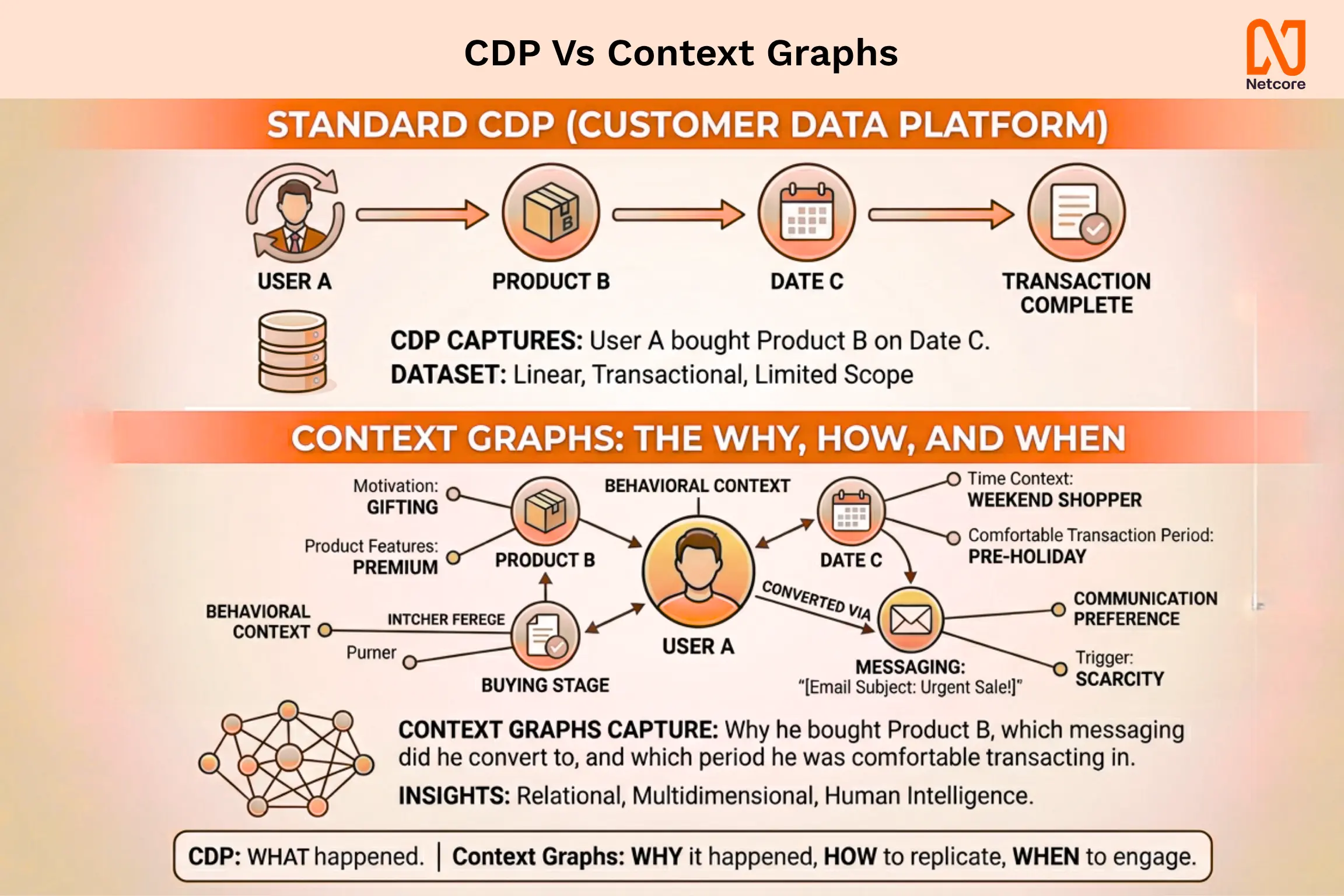
Most enterprises run on relational databases. CDPs are excellent at capturing transactional history: User A bought Product B on Date C. But as highlighted by TowardsDataScience, context graphs are necessary to capture the reasoning connecting inputs to outputs, moving beyond flat relational databases to map complex, multidimensional relationships over time.
To operationalize tribal knowledge, you must transition from storing “state” to storing “reasoning.” A context graph doesn’t just log that an email was opened; it maps the relationship between the customer’s current attention span, their historical preference for specific content formats (like quizzes vs. plain text), and their precise fatigue threshold.
| Capability | Traditional CDP (Relational) | Context Graph (Reasoning Data) |
| Data Structure | Flat tables, isolated event logs, transactional histories. | Nodes (entities) and edges (relationships), mapping behavioral context. |
| Core Metric | What happened? (Opens, clicks, purchases) | Why did it happen? (Intent, fatigue, streak momentum) |
| AI Application | Predictive scoring (propensity to buy). | Autonomous orchestration (safely determining the exact next action). |
| Business Impact | Enables manual segmentation and triggered automation. | Enables Agentic marketing platform to take accountability for revenue KPIs. |
When you engineer a digital trail that captures this reasoning data, your AI stops guessing. It relies on the context graph to know exactly when to push for a sale and when to prioritize earning attention. This is not merely an IT initiative; it is the fundamental prerequisite for transforming how your marketing department generates profit.
How do context graphs fuel Agentic marketing platform to actually own your KPIs?
If you ask a traditional, VC-backed SaaS vendor to tie their software fees directly to your revenue growth, they will refuse. Their platforms are built to sell you features and capacity, charging you for messages sent, regardless of whether those messages generate a return or simply annoy your customers into churning. They lack the context graph required to underwrite the risk of a true partnership.
Agentic marketing platform, powered by a context graph, changes this dynamic entirely. Because the graph retains organizational memory, the AI agent can be given a specific KPI, such as “increase 30-day repeat purchase rate by 12% without increasing unsubscribe rates,” and left to execute. The marketing team provides the boundaries. The AI agent tests, learns, and optimizes within those contextual boundaries, ensuring it never burns the audience to hit a short-term metric.
When the infrastructure is this intelligent, the business revenue growth can finally shift.
How does the economics of memory eradicate the Reacquisition Tax?
To understand the commercial power of the context graph, we must look at how it drives NeoMarketing’s two-engine architecture: Meridian and Atrium. These systems were built to operationalize the 3 NEVERs: Never Lose Customers, Never Pay Twice, Never Pay Fixed.
Context Graphs are the shared memory layer powering the Meridian (outcomes) and Atrium (attention) engines. They track the preferences, fatigue, streaks, and intent necessary to eliminate AdWaste entirely.
Here is how the architecture eradicates the Reacquisition Tax across your audience:
- Meridian: Monetizing the “Best” Customers
For your highly engaged customers, Meridian acts as the outcomes engine. Relying on the context graph, Agentic marketing platform determines the precise sequence to deepen relationships and expand lifetime value. Based on their loyalty score, send offers to VIP customers, giving them free deliveries, special access prior to new product launch, etc.
- Atrium: Earning Attention from the “Rest”
Customers don’t churn overnight; their attention decays gradually. Atrium is the attention engine. Before the customers slide into dormancy, the Atrium model deploys NeoMails. These are not promotional blasts that interrupt, but daily habit engines featuring interactive Magnets (quizzes, polls) that reward engagement with “Mu”, a visible attention currency. The context graph tracks these interaction streaks, transforming email from a cost center into a self-funding attention asset.
- NeoNet: Cooperative Recovery for the “Test”
When a customer finally stops opening your emails, traditional platforms give up, forcing you to pay ad networks to reach them. Instead, the context graph triggers NeoNet, a cooperative recovery network. Your highly relevant ActionAd is placed inside an engaged email from a complementary partner brand. You borrow attention deterministically, avoiding the probabilistic auction fees of ad tech entirely. Well, currently, this is a vision shared by Netcore’s founder, Rajesh Jain.
The escalation sequence is explicit and governed entirely by the context graph: earn attention at zero cost first (NeoMails), borrow attention at a cooperative cost second (NeoNet), and only buy attention from ad networks as an absolute last resort. This is how organizational memory translates directly into gross margin.
Final Take
To evolve from manual campaign automation to an Agentic marketing platform that can take true accountability for outcomes, an enterprise must first codify its implicit tribal knowledge into a Context Graph. Traditional martech fails because it remembers transactions but forgets attention, leading directly to the massive cost of the Reacquisition Tax. Without a context-aware reasoning layer, AI is just a faster way to make generic mistakes at scale. With it, AI becomes an outcomes-driven engine that ensures your brand never pays twice to reach the customers you already own.
Stop paying for software features and start paying for guaranteed results. Discover how you can build Context Graphs and make most of our organisational learnings over time. Talk to us.