





It’s 2026. Look around your marketing organization. You see your strategists, your copywriters, and your data scientists. But there’s a new presence in the cloud, one that doesn’t drink coffee, doesn’t sleep, and definitely doesn’t ask for a mental health day after Black Friday.
For years, we viewed AI as a tool, a sophisticated hammer we had to swing ourselves. We commanded it: “Write this subject line,” “Segment this audience,” or “Predict this churn. It was helpful, but passive. It waited for the button push.
The era of passive technology is over. We are entering the age of Agentic AI.
To understand where we are going, we have to look at how quickly the paradigm has shifted:
- The Predictive Decade (2010s–2022): This era was defined by Discriminative AI. These systems were “reactionary,” designed to classify data, predict churn, and recommend content based on past behavior.
- The Generative Pivot (2023–2024): The focus shifted to creation. AI became a powerful collaborator capable of synthesizing information and generating human-like text, images, and code.
- The Agentic Frontier (2025–2026): We are moving beyond “chatting” to “operating.” Agentic AI doesn’t just suggest a plan; it executes it, reasoning through multi-step workflows, using external tools, and achieving goals with supervision.
We are witnessing a monumental shift from tools that assist to systems that act. The market reflects this urgency, with the Agentic AI sector projected to hit nearly $200 billion in the next decade.
Why? Because brands are tired of tools. They want outcomes.
The Shift: From “Campaigns” to “Outcomes” You are now moving to goal-based orchestration
Traditional marketing automation is like a train on a track. You build the rails (the workflow), and the train follows them. Agentic AI is an off-road 4×4. It doesn’t follow a rigid path. Instead, you give it a destination, such as: “Maximize sell-through of the Spring Collection while maintaining a 15% margin. The AI then figures out the route, steering, accelerating, and changing lanes based on real-time road conditions.
This capability is critical because 60-70% of potential value in marketing personalization is currently lost due to “latency, the time gap between a customer signal and a brand’s response. Agentic AI eliminates this latency by acting autonomously in milliseconds.
Here’s What This Looks Like in Action
Imagine you are a marketing lead. Instead of spending two weeks building segments, you simply type a prompt into your Co-Marketer platform, like that of Netcore’s:
“Help me create a campaign to boost AOV by 15% for high-intent shoppers.”
You hit enter. In the next 60 seconds, a complex, silent negotiation takes place between four specialized agents. They don’t just execute; they debate the best path forward.
1. The Insights Agent (The Strategist)
This agent asks, “What usually drives AOV up for us?”. Scanning 12 months of data, it notices a pattern: customers buying premium denim rarely buy a second pair, but 40% buy a leather belt if prompted. It rejects a generic discount (which erodes margins) and proposes a “Complete the Look” strategy focused on high-margin accessories.
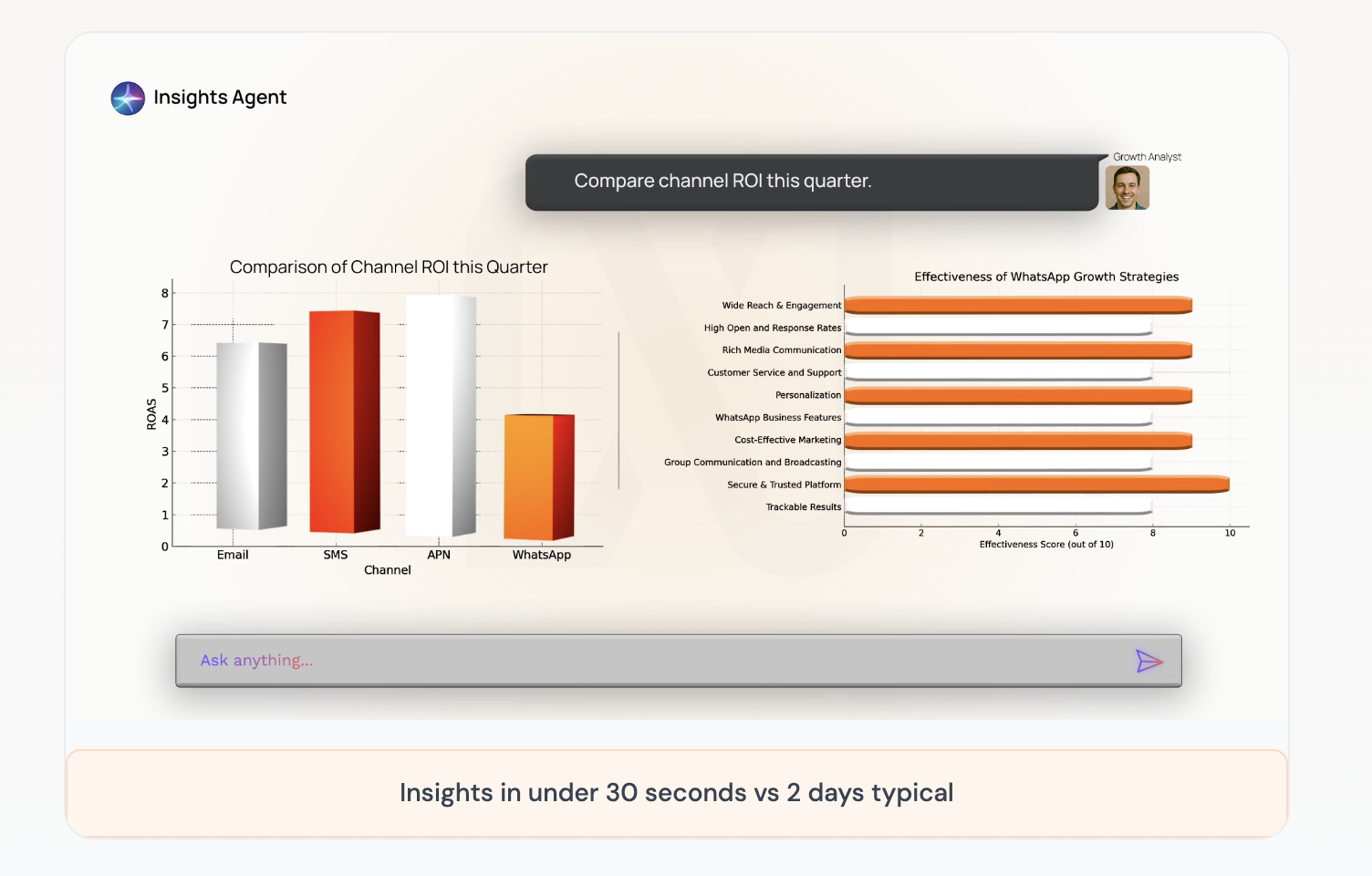
A typical insight generation workflow powered by Netcore’s Insights Agent
2. The Segment Agent (The Hunter)
It ignores broad lists like “Visited Site in Last 30 Days”. Instead, it looks for micro-signals: users viewing size guides (high fit intent) or revisiting the same product 3+ times. It creates a dynamic micro-cohort called “High_Intent_Accessory_Upsell” containing 14,500 users who fit this exact psychological profile.
3. The Content Agent (The Creative)
Adhering to the brand voice (“Witty, Direct, Premium”), it generates variants to test. It instantly pulls the highest-res image of the matching belt and overlays it next to the jeans the user viewed, creating a custom visual that feels like a personal stylist laid it out. With a single click, the system generates a full campaign plan, ready for review and approval by the marketer, or in the future, a dedicated brand and compliance agent.
4. The Scheduler Agent (The Traffic Controller)
Analyzing historical open rates, it determines this cohort browses at lunch but buys after dinner. It schedules the email for 7:45 PM, catching them exactly when they are on the couch with a credit card nearby.
Get Early Access to the Future of Agentic AI
The Intelligence Layer: Reasoning Over Rules
The core differentiator of Agentic AI is its ability to process context, not just data. It understands the why behind a purchase. Consider a traditional setup: if a customer buys a winter coat, automation might recommend a scarf. Logical, but basic. Agentic AI digs deeper. It notices “Sarah,” a loyal customer, has been browsing cardigans but abandoning her cart. Correlating this with local weather data showing a temperature rise, the AI drafts a message: “Trade the heavy coat for something lighter, perfect for next week’s sun”.
This isn’t a rule you wrote. It’s a connection the AI made.
Dynamic Execution & External Awareness
The real power of Agentic AI lies in its ability to pivot mid-flight. Imagine a Valentine’s Day campaign is struggling. The Insights Agent flags that the “Highly Engaged” segment isn’t converting due to price friction. The agents confer and autonomously suggest a fix: adding a “Free Travel Size” gift for orders over $75. Once approved, the Content Agent rewrites the creative instantly. Revenue unblocked.
Furthermore, Agentic AI integrates externalities like weather and inventory. If a blizzard is forecast for the Northeast, the system triggers a “Snowbound” micro-segment, prioritizing waterproof trekkers for customers in New York with copy reading: “Storm coming? Be ready with overnight shipping. Simultaneously, if size 9s are low in stock, the Segment Agent stops showing that specific boot to prevent bad UX.
The Storefront: The Netcore Unbxd Shopping Agent
While backend agents optimize campaigns, the most visible shift happens on the storefront. Enter the Netcore Unbxd Shopping Agent, a conversational AI that transforms the traditional “grid of products” into a guided discovery experience. Check it out by watching this video –
Check out Netcore Unbxd’s Shopping Agent Today
The Benchmark: How Crocs Achieved 13X ROI
Theory is fine, but let’s talk proof. Crocs faced the challenge of scaling personalization to millions without hiring an army of marketers. They deployed an AI Multi-Agent strategy with Netcore.
- The Strategy: Instead of static rules, they used AI Propensity Segmentation to predict not just who would buy, but what specific Jibbitz or clog style they craved.
- The Execution: Content Agents optimized creative in real-time across WhatsApp and Email, while Segment Agents identified users who were cooling off and engaged them with precise timing.
- The Impact: Crocs achieved a staggering 13X ROI with AI Multi-Agent Models and 42X ROI overall from the personalization suite.
Read the full Crocs Success Story here
Conclusion:
We are moving from a world of Campaigns, distinct, manual bursts of activity, to a world of Continuous Optimization. Agentic AI is the infrastructure for this new reality, allowing you to treat every customer interaction as a unique data point that informs the next move, instantly.
The technology isn’t on the horizon; it is already driving 13X ROI for market leaders. The only question remaining is: What goal will you give your agents today?
Discover how Netcore’s Agentic Marketing Platform can transform your brand