





TL;DR
- Agentic AI in marketing refers to autonomous AI agents that observe customer behavior, make decisions, and act in real time—without waiting for human intervention.
- Agentic AI is transforming marketing by closing the gap between insight and action, enabling brands to respond while attention and intent still exist.
- Its core characteristics include continuous perception, goal-driven decision-making, real-time execution, and adaptive learning.
- Key use cases span hyper-personalization, conversational engagement, journey orchestration, product discovery, and workflow automation.
- The benefits include faster time-to-action, higher relevance at scale, improved conversion and retention, reduced operational overhead, and more predictable ROI.
- Netcore applies Agentic Marketing across the customer lifecycle using coordinated AI agents for insights, segmentation, content, scheduling, and agentic commerce—turning campaigns into continuous, intelligent engagement.
Most marketing teams aren’t struggling because they lack data, tools, or ideas.
They’re struggling because everything now happens faster than humans can respond.
A customer browses three products at lunch.
Compares prices on a competitor site at 4 pm.
Ignores your push notification at 7 pm. And disappears entirely by the weekend.
By the time this shows up in a dashboard, the moment to act is already gone.
This is the gap Agentic AI in marketing is designed to close.
The Real Marketing Problem No One Talks About
Let’s start with a familiar scene.
Your team launches a campaign.
Open rates look fine. Clicks are decent. Conversions trickle in.
But two weeks later:
- Repeat engagement drops
- Campaign fatigue creeps in
- CAC inches upward
- Retention stalls
Nothing is “broken” enough to trigger alarms. Yet growth slows anyway.
What’s happening isn’t poor execution. It’s attention decay, and it’s happening between reports, between reviews, between human decisions.
Traditional marketing systems were built to analyze after the fact.
Modern marketing requires systems that act while intent still exists.
What Is Agentic AI in Marketing?

Agentic AI in marketing refers to autonomous AI systems, known as AI agents, that can perceive customer signals, make decisions, and take action without requiring human intervention.
Traditional marketing AI answers questions like:
- What happened?
- What is likely to happen?
- What should we do next?
Agentic AI goes one step further:
- It does something about it, immediately.
In practice, marketing agents don’t just surface insights or recommend actions. They:
- Monitor real-time customer behavior
- Detect changes in intent or attention
- Decide the next best action
- Execute across channels automatically
This shift from insight to action is what makes agentic marketing fundamentally different.
Why Agentic AI Is Transforming Marketing
A lack of data or tools no longer constrains marketing. It’s constrained by reaction speed.
Customer intent now shifts in minutes, not weeks. Attention is won and lost between sessions, across channels, and outside campaign cycles. In this environment, systems designed to analyze first and act later are structurally misaligned with reality.
This is why the future of marketing is agentic, and agentic ai in ecommerce is rapidly gaining importance.
According to PwC (2025), 66% of organizations that have adopted agentic systems are already reporting measurable marketing uplifts, from higher engagement and conversion rates to improved retention and efficiency. These gains aren’t coming from better dashboards or more sophisticated reports. They’re coming from systems that can observe, decide, and act autonomously.
Traditional marketing models rely on humans to interpret insights and initiate action. Agentic AI removes this delay by embedding decision-making directly into the system. Instead of waiting for teams to spot patterns, prioritize tasks, and launch responses, agentic systems intervene in real time, while customer attention is still present and intent is still fluid.
As customer journeys become more fragmented and expectations for relevance rise, marketing can no longer afford to be episodic or reactive. Agentic AI transforms marketing from a sequence of campaigns into a continuous decision engine, one that adapts moment by moment.
In short, agentic AI isn’t transforming marketing because it’s more advanced.
It’s transforming marketing because it’s better aligned with how customers actually behave today.
Core Characteristics of Agentic AI
- Goal-Oriented Behavior: Focuses on high-level outcomes, like reducing checkout hesitation, rather than simply executing repetitive tasks like “sending an email.”
- Continuous Perception: Constantly monitors subtle behavioral signals (e.g., longer pauses or session drops) that human analysts often miss between manual reporting cycles.
- Autonomous Decision-Making: Independently chooses the best intervention—whether to guide, simplify, or wait—to eliminate the “time lag” that kills conversion rates.
- Real-Time Action: Triggers immediate responses the moment a customer hesitates, ensuring relevance is restored instantly rather than waiting for next week’s campaign.
- Self-Improving Learning: Dynamically adapts by reinforcing successful interventions and discarding failed ones, evolving the strategy from static optimization to a self-improving system.
Key Agentic AI Marketing Use Cases
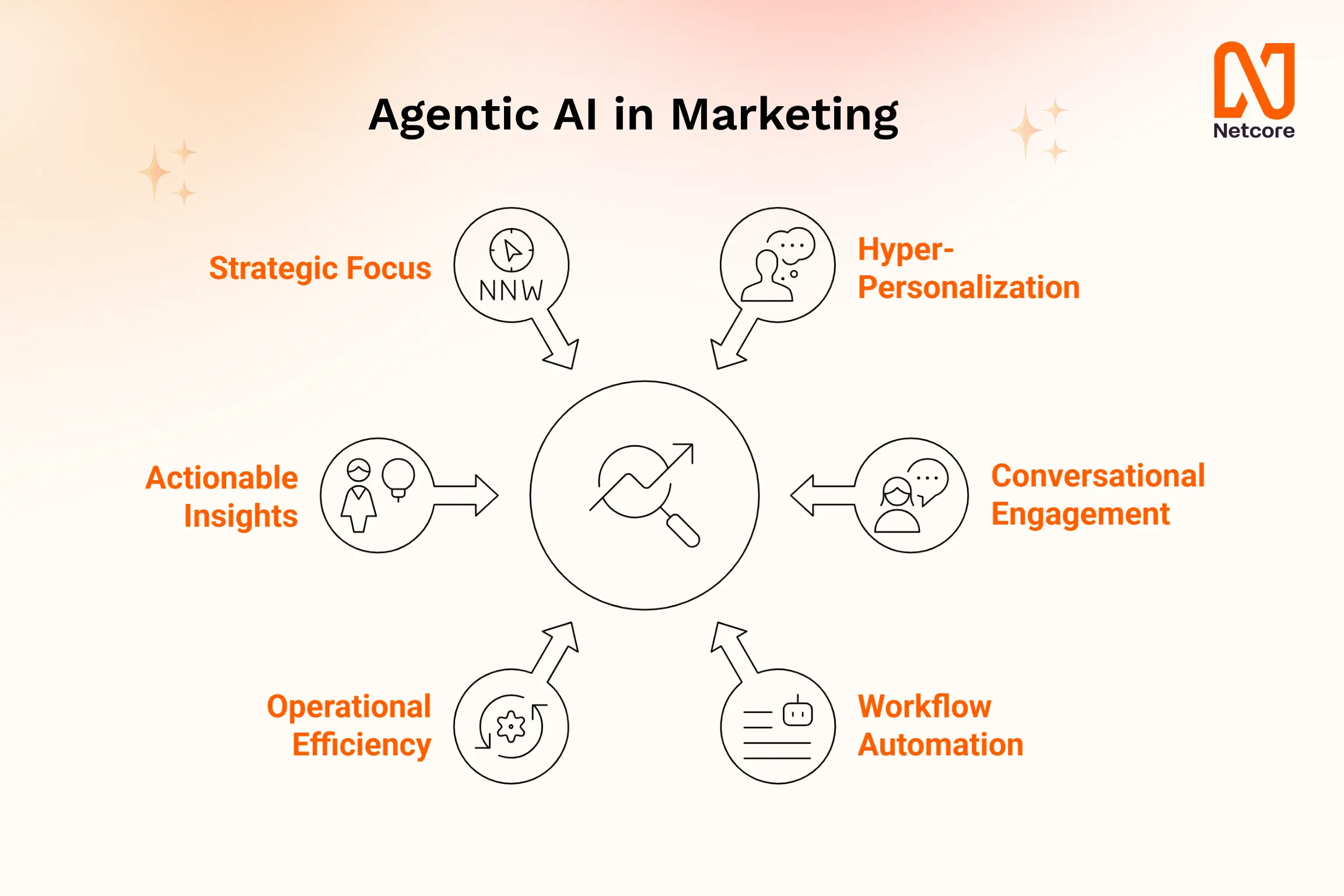
Agentic AI moves marketing from broad execution to precision at scale. Instead of relying on static rules or periodic optimization, agentic systems operate continuously—adjusting experiences, workflows, and decisions in real time.
Below are the most impactful ways agentic AI marketing use cases are being applied in modern marketing.
- Hyper-Personalization at Scale
Traditional personalization breaks when scale increases. Teams are forced to choose between relevance and reach.
Agentic AI removes this trade-off by delivering tailored content, offers, and experiences at the individual level—automatically. AI agents in marketing adapt messaging based on real-time behavior, context, and intent, not predefined segments.
In practice, this means two customers visiting the same page can see entirely different experiences, driven by their unique signals rather than broad assumptions.
- Conversational Customer Engagement
Customers increasingly expect conversations, not campaigns.
Agentic AI enables context-aware, conversational engagement across channels—responding intelligently to customer actions, questions, or hesitation. By leveraging agentic ai in retail, brands can guide, clarify, and reassure in the moment, creating interactions that feel helpful rather than interruptive.
This is especially powerful in product discovery, onboarding, and post-purchase engagement.
- Workflow Automation and System Orchestration
Modern marketing stacks are complex by default.
Agentic AI acts as an orchestration layer, automating workflows across systems and ensuring the right actions happen in the right tools at the right time. From triggering journeys to syncing data and coordinating channels, AI agents in marketing reduce manual handoffs and operational friction.
The result is faster execution with fewer failure points.
- Enhanced Operational Efficiency
Agentic AI automates routine and repetitive tasks—content assembly, audience updates, scheduling decisions—freeing teams from operational overload.
This boosts campaign velocity and content output without increasing headcount, allowing marketers to focus on strategy, experimentation, and creativity rather than execution logistics.
- Deeper, Actionable Insights
Most analytics platforms stop at insight.
Agentic AI goes further by processing vast datasets continuously to surface not just what’s happening, but what matters right now—and what action should follow. These insights are contextual, prioritized, and immediately actionable, closing the gap between analysis and execution.
- Strategic Focus for Marketing Teams
As marketing agents take over execution-heavy work, marketing teams gain space to focus on higher-order decisions:
- Brand strategy
- Experience design
- Long-term growth planning
Agentic AI doesn’t replace marketers. It elevates their role, from operators to strategists.
Benefits of Agentic AI in Marketing
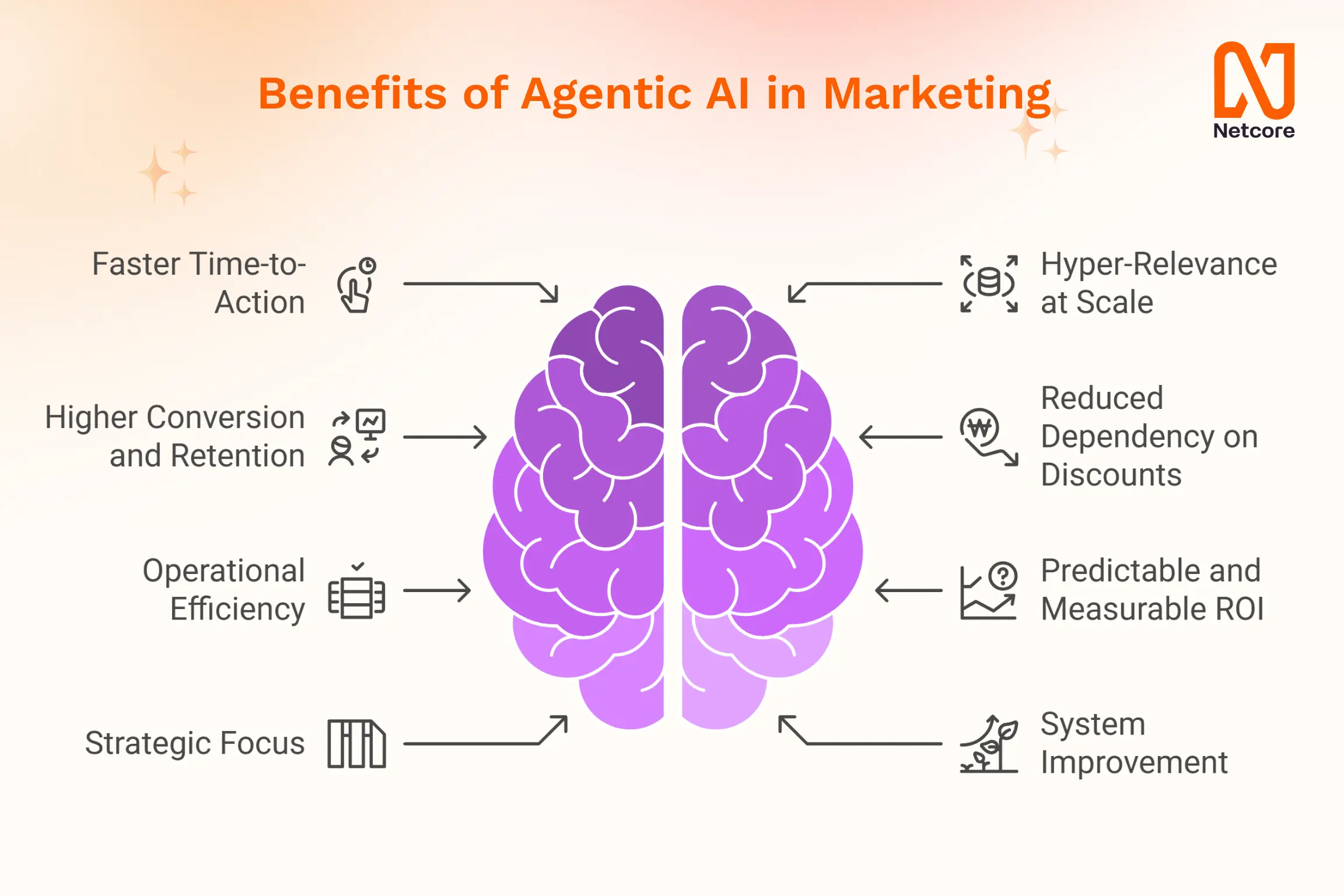
Agentic AI doesn’t just make marketing faster. It makes it structurally more effective.
The value of agentic AI shows up where most teams struggle today: responding in time, staying relevant at scale, and turning insight into action without friction. Below are the most meaningful agentic AI benefits that marketers experience when they move to an agentic model.
1. Faster Time-to-Action
In traditional marketing, time is the invisible cost.
A signal appears.
Data gets logged.
Someone reviews a dashboard.
A decision is made.
A campaign is scheduled.
By the time action happens, the moment has passed.
Agentic AI collapses this cycle. AI marketing agents detect shifts in behavior or intent and act immediately, not in the next planning window. This is critical because attention and intent are transient. The brands that respond first are the ones that remain relevant.
2. Hyper-Relevance at Scale
Most personalization systems break at scale. The more customers you have, the more generic messaging becomes.
Agentic AI reverses this dynamic.
By continuously observing individual behavior, AI marketing agents tailor content, offers, timing, and frequency at the user level, without requiring marketers to predefine every scenario. This allows brands to maintain 1:1 relevance across millions of interactions, something human-led systems simply can’t sustain.
3. Higher Conversion and Retention Through Early Intervention
Conversions don’t fail at checkout.
They fail much earlier, when attention begins to slip.
Agentic AI detects early signs of disengagement and intervenes while intent is still recoverable. Whether it’s simplifying a choice, offering guidance, or reducing message volume, AI agents act before disengagement turns into churn.
This leads to:
- Higher conversion rates
- Lower churn
- More stable lifetime value
Because problems are solved upstream.
4. Reduced Dependency on Discounts and Interruptions
When relevance drops, brands compensate with incentives.
Agentic AI reduces this dependency by preserving attention through relevance rather than pressure. Customers receive fewer but more meaningful interactions, which decreases the need for aggressive discounting and over-messaging.
The outcome is healthier margins and more sustainable growth.
5. Operational Efficiency Without Sacrificing Quality
Marketing teams are often stretched thin—not by lack of ideas, but by execution overhead.
Agentic AI automates repetitive tasks like:
- Updating segments
- Selecting content variations
- Deciding timing and frequency
- Orchestrating workflows across systems
This increases campaign speed and output without increasing headcount—while improving consistency and quality.
6. More Predictable and Measurable ROI
Because agentic AI decisions are continuous and data-driven, outcomes become more predictable over time.
Instead of relying on periodic performance reviews, teams can track:
- Attention retention
- Engagement continuity
- Early recovery signals
- Conversion likelihood before campaigns launch
This allows marketers to allocate resources more confidently and measure ROI earlier in the lifecycle.
7. A System That Improves Over Time
Traditional marketing systems reset with every campaign.
Agentic AI systems learn continuously. Each interaction refines decision-making, improving relevance and efficiency with use. Over time, this creates a compounding advantage that’s difficult for competitors to replicate.
Why This Matters Now
As customer attention becomes more fragmented and expectations for relevance rise, the cost of reacting late grows every quarter.
Agentic AI doesn’t just help marketers keep up.
It reshapes how marketing works, from episodic execution to continuous, intelligent engagement.
That’s the real benefit.
How to Apply Netcore’s Agentic Marketing Platform Across the Customer Lifecycle

Agentic marketing platform delivers the most value when it’s applied end to end, from first interaction to repeat purchase and beyond. Netcore’s agent-based platform is designed around this lifecycle thinking, with each agent owning a distinct responsibility while working in coordination with the others.
Together, they replace fragmented campaigns with a continuous, intelligent engagement system.
Content Agent: Turning Ideas Into On-Brand, Cross-Channel Experiences
Content creation is one of the biggest bottlenecks in modern marketing. Teams have ideas, but execution slows down across drafting, approvals, formatting, and channel-specific adaptation.
The Content Agent removes this friction by enabling prompt-to-publish content creation across channels.
With a single prompt, marketers can generate multi-channel content—emails, push notifications, WhatsApp messages, and more—without rewriting for each format. Streamlined editing and one-click deployment allow teams to launch campaigns faster, without sacrificing quality or control.
What sets the Content Agent apart is brand authenticity at scale. It crafts campaign titles, descriptions, and messaging that align with your unique brand voice, ensuring AI-generated content doesn’t feel generic or off-brand. An extensive template library provides instant inspiration, helping teams move from idea to execution quickly.
The agent also maintains cross-channel brand consistency, ensuring tone, messaging, and structure remain aligned across all customer touchpoints. Behind the scenes, it automatically adapts content to the best practices and technical requirements of each channel—so messages are optimized without manual rework.
Where it fits in the lifecycle:
Awareness, consideration, re-engagement, and retention—any moment where relevance and speed matter.
Scheduler Agent: Reaching Customers When (and Where) They’re Most Receptive
Timing and channel choice often determine whether a message feels helpful or intrusive.
The Scheduler Agent brings intelligence to both.
Instead of relying on fixed schedules or broad assumptions, it uses channel preference intelligence to identify which channels work best for each customer or segment. Some users respond better to email, others to push or WhatsApp—and the Scheduler Agent learns and adapts accordingly.
It also applies send-time optimization, delivering messages at the moments when individual recipients are most likely to engage. This directly improves open rates and engagement without increasing message volume.
Equally important is strategic communication pacing. The Scheduler Agent sets intelligent intervals between messages, ensuring customers aren’t overwhelmed. In periods of low attention, it can slow down outreach; when intent is high, it can accelerate engagement.
Where it fits in the lifecycle:
Ongoing engagement, conversion moments, and retention—especially where attention fatigue is a risk.
Insights Agent: Turning Data Into Decisions, Not Dashboards
Most teams have access to analytics. Few have access to actionable intelligence.
The Insights Agent closes this gap by moving beyond reporting into real-time interpretation and recommendation.
It analyzes customer behavior across journeys to uncover hidden patterns, anomalies, and early warning signals—such as attention decay or unexpected drops in engagement. Automated revenue analysis highlights significant changes and identifies contributing factors, helping teams understand not just what changed, but why.
Crucially, the Insights Agent doesn’t stop at observation. It delivers recommendation-driven insights, suggesting concrete actions rather than overwhelming teams with data dumps.
Its intelligence framework operates across three dimensions:
- Descriptive & Predictive: What’s happening and what’s likely next
- Diagnostic: Why it’s happening
- Prescriptive: What to do about it
Where it fits in the lifecycle:
Across all stages—guiding decisions, prioritizing actions, and informing other agents in real time.
Shopping Agent: Guiding Customers From Discovery to Conversion
Product discovery is where many conversions are quietly lost—not because of lack of intent, but because of friction, overload, or uncertainty.
The Shopping Agent is designed to actively guide customers through this phase.
It uses shopper-specific AI models, trained on your customer data and product catalog, to deliver more relevant discovery experiences. As users browse or search, the agent can dynamically propose relevant filters based on their queries, helping them narrow choices without effort.
The Shopping Agent also plays a proactive role in re-engagement. If a shopper becomes inactive or hesitates for a defined period, it can automatically reach out with relevant questions or suggestions, restarting the conversation instead of letting intent fade.
What makes this especially powerful is the ability to train the agent using in-house sales intelligence. Brands can configure how the agent responds, which products it prioritizes, and the tone it adopts, ensuring alignment with real-world selling strategies.
Deployment is simple, with flexible integration options that allow teams to activate the Shopping Agent without disrupting existing systems.
Where it fits in the lifecycle:
Consideration, evaluation, and conversion—especially in complex or high-choice environments.
How the Agents Work Together Across the Lifecycle
Individually, each agent solves a specific problem. Together, they form an agentic system:
- Insights Agent detects intent shifts or attention decay
- Content Agent generates relevant, on-brand messaging
- Scheduler Agent decides when and where to engage
- Shopping Agent guides users toward conversion
This coordination enables continuous, adaptive engagement—from first interaction through repeat purchase, without relying on manual orchestration.
Why This Matters
Most marketing stacks are optimized for execution.
Netcore’s agentic platform is optimized for decision-making at scale.
By applying agentic marketing across the customer lifecycle, brands move from reacting to outcomes to shaping them in real time—preserving attention, accelerating conversion, and building long-term customer value.
That’s the real power of Agentic Marketing.
Final Take
Marketing is moving too fast for reactive, manual execution to keep up. Agentic AI helps teams act in real time—protecting attention, improving relevance, and turning insight into action without delay.
By bringing AI agents into everyday marketing workflows, teams spend less time reacting and more time shaping outcomes. It’s not about replacing marketers, it’s about enabling them to operate at the speed modern customers demand.
Getting started doesn’t mean overhauling your stack overnight. It starts with understanding where agentic systems can remove friction and create immediate impact across the customer lifecycle. If you’re ready to move from campaigns to continuous, intelligent engagement, consult Netcore to see how Agentic AI can fit into your marketing today.

