





In this blog, we unpack why customer retention platform migrations often fail, what it takes to protect data integrity during transitions, and how to execute a low-risk CRM migration without slowing growth.
TL;DR
- What data integrity truly means in customer retention platforms, and why it matters during migration.
- A practical, end-to-end 8-step checklist to plan and execute a CRM/CEP migration.
- The most common migration challenges teams face, and how to anticipate them.
- How to evaluate and choose a platform that minimizes migration risk by design.
- How brands can complete a fast, low-risk CEP migration with Netcore, without disrupting live campaigns.
Data migration is one of the most underestimated risks in customer retention.
On paper, it looks straightforward: export data from one platform, import it into another, reconnect channels, and move on. In reality, migrations often become the moment when customer trust, campaign performance, and internal confidence quietly break down.
Journeys stop firing. Personalization feels off. Deliverability dips. Teams hesitate to launch campaigns because they’re unsure whether the data is reliable.
That’s because migrating to a customer retention platform (CRM) is not just a technical task. It’s a trusted event for your customers and your teams.
Why Data Migration Is the Riskiest Moment in Customer Retention

Unlike traditional CRMs, customer retention platforms sit at the center of live customer engagement.
They power:
- Email, SMS, RCS, WhatsApp, push notifications
- Real-time journeys and triggers
- Personalization, recommendations, and search
- Lifecycle measurement and KPIs
When data integrity breaks here, the impact is immediate and visible.
Common migration fears include:
- Losing historical customer data
- Breaking automated journeys
- Deliverability issues across channels
- Incorrect segmentation and targeting
- Inconsistent KPIs post-migration
And most of these issues don’t surface on day one. They appear weeks later, when campaigns underperform, and teams can’t tell whether the strategy failed or the data did.
What “Data Integrity” Really Means in a Customer Retention Platform
Data integrity is often misunderstood as “no data loss.”
In retention platforms, it means much more. Here’s an article about key features a customer retention platform should have.
True data integrity ensures:
- Accuracy – customer attributes, events, and consent are correct
- Completeness – profiles contain all relevant historical and behavioral data
- Consistency – the same customer behaves the same way across channels
- Usability – data actually powers journeys, personalization, and analytics
Retention platforms are inherently complex because they combine:
- Identity resolution (email, phone, device, app user IDs)
- Event-level behavioral data
- Channel-specific engagement data
- Real-time triggers and decisioning
If integrity breaks at any layer, personalization and automation collapse.
That’s why migrations need structure, not speed alone.
CRM Migration Checklist
- Get the Team Ready
Form a cross-functional migration squad and define clear ownership, timelines, and success metrics. - Review Your Existing CRM
Audit data quality, journeys, and segments—remove duplicates and retire unused assets. - Choose the Right CRM Platform
Select a platform built for retention with strong migration support, unified data, and native channels. - Back Up All Customer Data
Secure complete backups of customer profiles, events, consent, and campaigns before migrating. - Create a Data Mapping Plan
Carefully map identities, attributes, events, and segments to the new platform’s data model. - Run a Test Migration
Migrate a subset of data to validate accuracy, journeys, and channel readiness. - Migrate to the New Platform
Execute a phased or parallel migration to ensure campaign continuity and minimal downtime. - Monitor Post-Migration Results
Validate data integrity, deliverability, KPIs, and team confidence after go-live.
Here’s the complete Customer Retention Platform Migration Guide to walk you through the full process of transitioning to a new platform.
Common CRM Migration Challenges You’ll Face
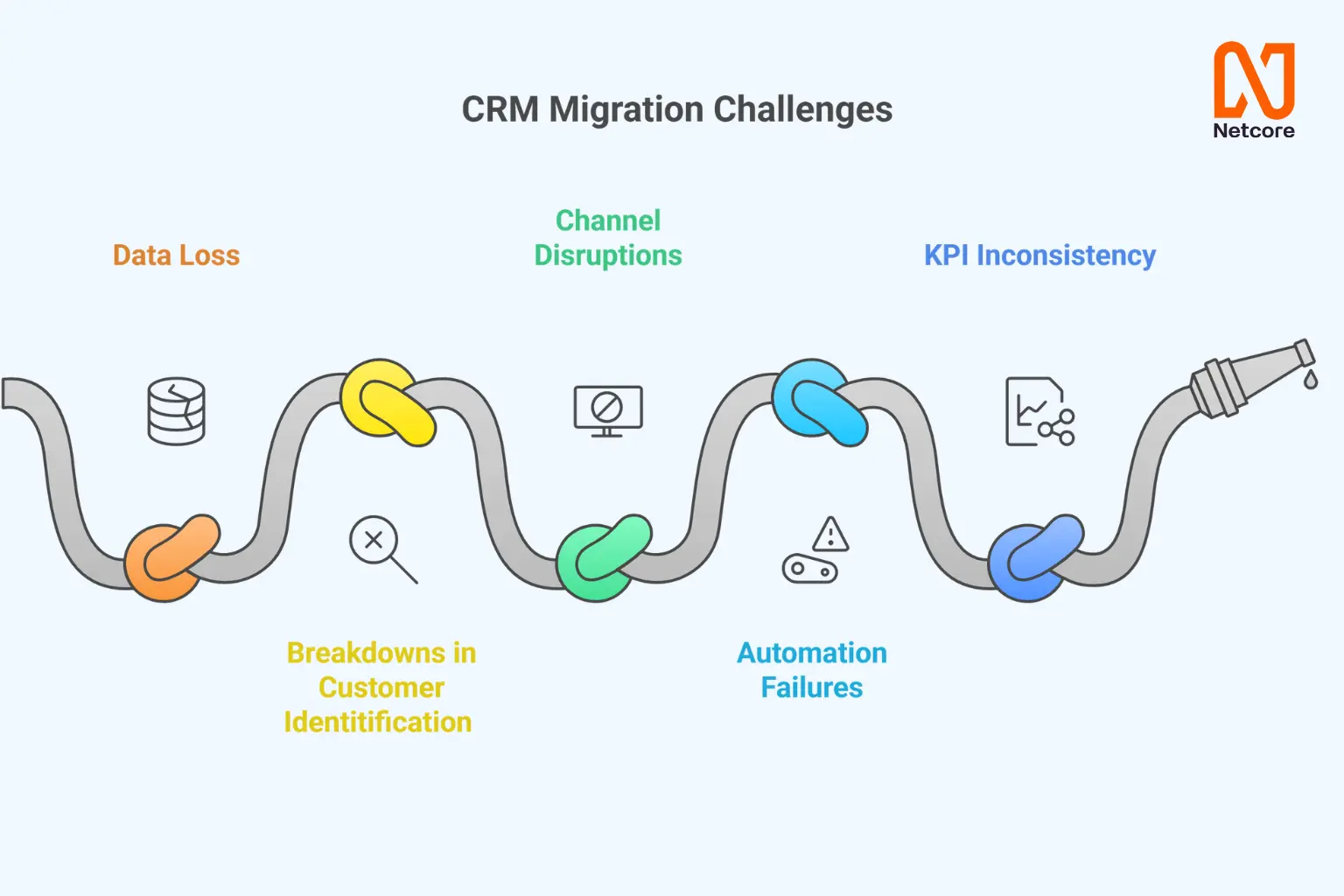
Most data migration CRMs don’t fail in dramatic ways.
They fail quietly, through small breakdowns that compound over time.
These challenges are not edge cases. They are structural risks that surface when customer data, channels, and journeys move systems. The teams that manage them well aren’t lucky, they’re prepared.
1. Data Loss or Corruption
Data loss rarely looks like missing rows in a table. More often, it shows up as attributes that no longer behave as expected, events that lose context, or historical data that can’t be activated.
This typically stems from rushed data mapping or incomplete backups. When integrity slips here, the downstream impact is felt in personalization accuracy and targeting confidence.
What starts as a data issue quickly becomes a growth issue.
2. Identity Resolution Breakdowns
Customer identity is inherently fragmented—email, phone, devices, apps, browsers.
During migration, weak identity resolution leads to duplicated or split profiles. The result is inconsistent messaging, repeated outreach, and journeys that feel disconnected.
When customers experience fragmentation, trust erodes—even if they can’t articulate why.
3. Channel Disruptions
Channels are often the most fragile layer during migration.
Email reputation can dip.
SMS or WhatsApp approvals can slow execution.
Push and app notifications can lose continuity.
These disruptions are usually not technical failures—they’re operational ones, caused by fragmented channel ownership and dependencies across vendors.
Engagement drops quickly when channels lose stability.
4. Journey and Automation Failures
Journeys depend on precise timing, triggers, and conditions.
Post-migration, teams often discover that:
- Triggers fire inconsistently
- Conditional logic behaves differently
- “Real-time” journeys become delayed workflows
Customers don’t see logic errors. They experience irrelevance.
5. KPI Inconsistency and Trust Gaps
One of the most common post-migration moments is quiet panic.
Metrics don’t align with historical benchmarks. Conversion rates look different. Attribution feels off. Teams hesitate to launch campaigns because they don’t trust the numbers yet.
Often, performance hasn’t changed—measurement has. But until alignment is restored, velocity slows.
Planning doesn’t eliminate these challenges. It ensures they don’t interrupt growth momentum.
How to Choose the Best CRM or Customer Retention Platform
The lowest-risk migrations happen when platforms are designed for retention from the ground up, not adapted to it later.
When evaluating a CRM or customer retention platform, the question isn’t feature breadth. It’s architectural suitability.
Criteria that consistently reduce migration risk:
- Unified customer data model
One system of record for identities, events, and attributes—without stitching data across tools. - Native multi-channel support
Email, SMS, RCS, WhatsApp, push, and in-app messaging are handled within the same platform. - Built-in consent and compliance controls
Preference and privacy data should migrate cleanly and remain enforceable by default. - Structured onboarding and migration support
Playbooks, test migrations, and parallel-run capability are indicators of maturity. - Fast activation of personalization
The platform should allow journeys, recommendations, and targeting to resume quickly, without rebuilding logic from scratch.
Platforms that simplify operations and take ownership of data integration naturally reduce migration risk.
Completing a Quick, Low-Risk Data Migration CRM With Netcore
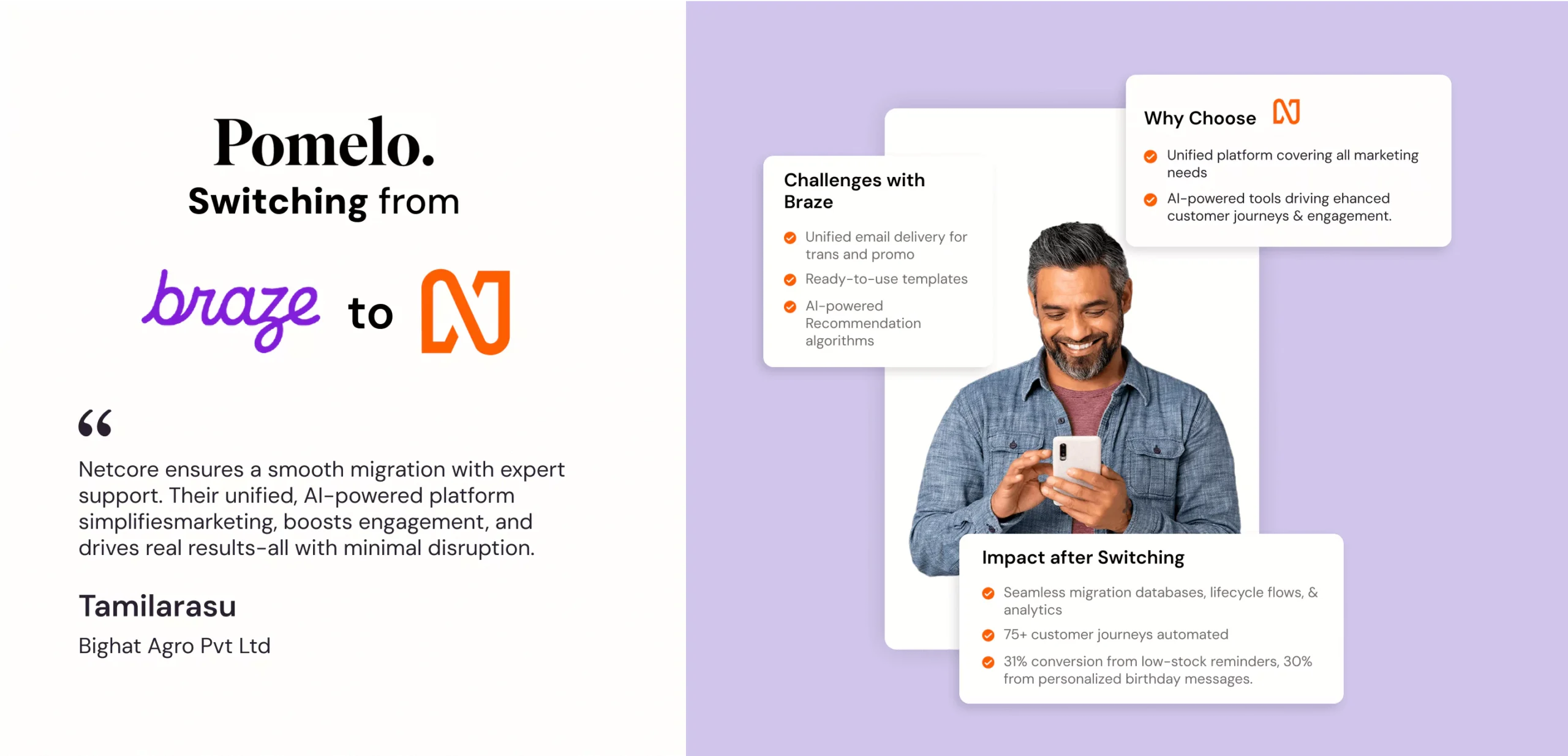
Netcore approaches migration with a clear premise: speed matters, but confidence matters more. We have a first-time integration success rate of 97%+.
The goal isn’t just to move data. It’s to ensure teams can operate, launch, and optimize without hesitation from day one.
Start Seeing Value in as Fast as 45 Days
Netcore’s migration framework is designed to compress time-to-value.
Rather than waiting months to stabilize data and campaigns, brands typically begin activating core journeys, channels, and personalization use cases within the first 45 days. This early momentum helps teams regain confidence quickly and prevents migration fatigue.
Zero-Disruption Migration While You Stay Live
Customer engagement doesn’t pause for platform changes, and neither should campaigns.
Netcore supports phased and parallel-run migrations that allow brands to:
- Keep campaigns live during transition
- Avoid channel downtime or customer-facing gaps
- Validate performance before fully switching over
This ensures continuity for customers and stability for revenue.
Dedicated Onboarding and Success Teams
Migration complexity often increases when responsibility is fragmented.
Netcore assigns dedicated onboarding and success teams who own the transition end-to-end—from data mapping and channel readiness to post-migration validation. Their role is not just execution, but interpretation, helping teams understand what’s changing and why.
Complexity is managed centrally, not passed downstream.
Strategic Guidance to Unlock ROI From Day One
Migration is most valuable when it’s paired with direction.
Beyond technical onboarding, Netcore provides strategic guidance on:
- Which journeys to activate first
- How to prioritize channels and use cases
- Where early wins can be unlocked quickly
This ensures the new platform isn’t just live, but is contributing to measurable outcomes immediately.
Proven Onboarding Checklists, So Nothing Slips Through
Successful migrations rely on discipline.
Netcore uses proven onboarding and migration checklists that cover:
- Data integrity validation
- Channel readiness
- Journey and trigger testing
- KPI alignment
This structured approach reduces reliance on tribal knowledge and ensures no critical step is overlooked, especially under tight timelines.
Taken together, these elements shift migration from a risky transition to a controlled upgrade.
The objective isn’t simply to complete the migration.
It’s to emerge with cleaner data, stronger execution, and teams ready to move faster than before.
Final Take
Customer retention platform migration is one of the few moments where data, technology, and customer trust intersect. Handled poorly, it introduces uncertainty—broken journeys, unreliable metrics, and hesitant teams. Handled well, it becomes a quiet but powerful upgrade.
The difference isn’t speed. It’s building a momentum. Clear ownership, structured migration steps, strong data integrity, and a platform designed for retention—not retrofitted for it—are what separate low-risk transitions from costly setbacks.
The safest migrations don’t interrupt growth. They preserve engagement, protect revenue, and give teams confidence to keep moving while the platform changes underneath.
Migration success isn’t measured by when data moves. It’s measured by how quickly teams trust the system enough to act, and how seamlessly customers experience the transition.