





This article breaks down the eight “impossible problems” modern marketers face and explores why only agentic marketing systems are capable of solving them.
Modern marketing isn’t broken; it is rigged against you. Every quarter, the same “impossible problem” plays out: ad budgets skyrocket while margins plummet, resulting in a massive wealth transfer from brands to ad platforms. We are currently trapped in a cycle of noise and saturation, forcing teams to rely on brand-eroding discounts just to re-acquire customers they already paid for.
The uncomfortable truth is that these challenges have outgrown human capacity. Data streams move too fast, and customer intent shifts too quickly for manual optimization. This widening gap drives massive ad waste and stifles real revenue growth.
This is why the most profitable, retention-led brands are quietly shifting to Agentic Marketing. Unlike traditional automation, which merely executes what it is told, agentic systems autonomously analyze, learn, and decide the best next move. Gartner Marketing Technology Survey found companies use 42% of their martech stack capabilities on average. The remaining 58% is unused or underutilized. To survive, you must stop competing against human limitations and start utilizing systems that adapt 24/7.
It is time to change the approach. Let’s break down how agentic marketing solves the impossible problems of modern marketing.
Problem 1: Reacquisition Disguised as Acquisition
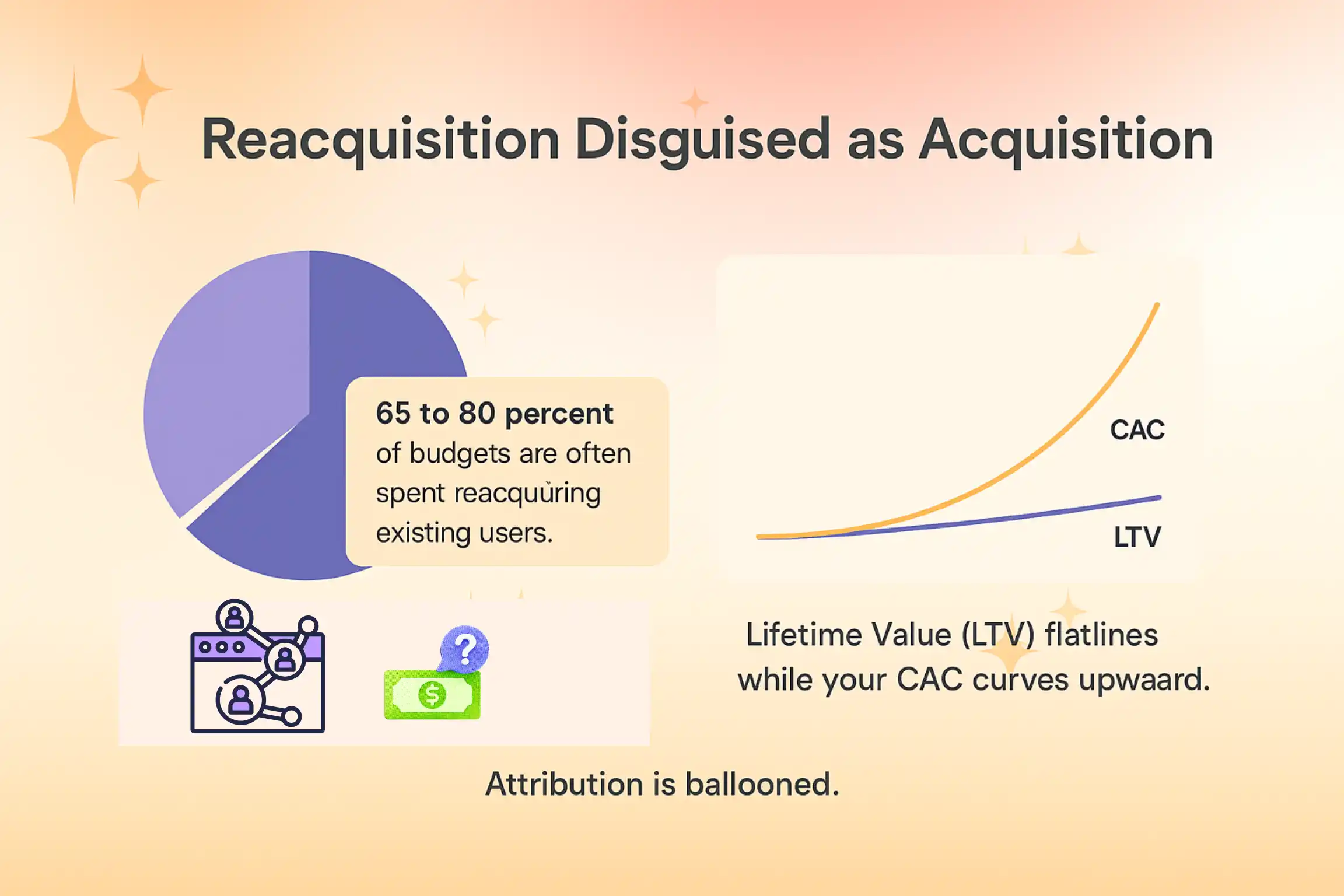
Roughly 70 per cent of so-called acquisition spend is actually reacquisition. Acquisition is so expensive that many brands are effectively re‑acquiring their own customers through paid ads every few months just to keep topline growing, instead of using owned channels and loyalty programs to drive repeat revenue.
The Symptoms
- 65 to 80 percent of budgets are often spent reacquiring existing users.
- Lifetime Value (LTV) flatlines while your CAC curves upward.
- Attribution is ballooned.
Why is it impossible for humans
No human team can track every single customer’s buying cycle, churn pattern, or intent decay manually. The data moves too fast. By the time a human analyst notices a customer is ready to buy, that customer has already searched on browser and clicked a competitor’s ad.
How Agentic Marketing solves the reacquisition problem?
Agentic systems do not wait for you to run a report. They predict who is about to buy again. They trigger owned-channel outreach, such as an email or a WhatsApp message, before paid channels have a chance to poach the user. This reduces reacquisition spend automatically and keeps that margin in your pocket.
Problem 2: The $500 Billion AdWaste Epidemic
Every year marketers spend $700 in digital advertising. $500 billion in Ad waste spent targeting customers who had already purchased earlier. That is a budget set on fire. This happens as brands fail to keep the attention already earned.
Why is Eliminating Ad Waste Impossible Manually?
You cannot stop ad platforms from retargeting your existing customers without real-time suppression logs and prediction models. Managing these lists manually is a slow and inefficient process.
How Agentic Marketing Solves AdWaste Problem
Agents handle real-time audience suppression. They identify customers who are already loyal or currently converting on organic channels and remove them from paid targeting lists instantly. Not only this but using Segment Agent from Netcore Cloud’s Agentic Marketing Platform, you can also identify users at risk of churn, users with high intent to buy again, etc. You can launch follow-up campaigns on these segments and convert purchases.
Problem 3: The Revenue Tax Trap
Most brands aren’t losing margin in one big hit. They’re bleeding it in small, “normal” decisions. A discount to convert cold traffic. A higher marketplace commission to keep sales volume. Another coupon to win back a customer who should never have left. Add it up, and you quietly surrender 20 to 30% of revenue as “revenue tax” to ad platforms, marketplaces, and constant discounting.

The Symptoms
- Discounting becomes your default growth lever, not a tactical tool
- Marketplace fees and paid media take a bigger bite each quarter
- Repeat purchases stall, so you keep paying to “re-win” the same customer
- Profit grows slower than revenue (or not at all)
Why is it impossible for humans to solve the revenue tax problem
No team can manually spot, in real time, who is slipping, who is price-sensitive today, who is likely to churn tomorrow, and what message will save the margin. Humans work in batches. Customer intent changes hourly. By the time you notice revenue leakage in a dashboard, the leak has already become your “new normal.”
How Agentic Marketing solves it
Agentic systems attack the tax at the source. They:
- Predict churn and price sensitivity early, before discounting becomes necessary
- Shift demand to owned channels (email, WhatsApp, SMS, push) using first-party data, so you rely less on paid re-targeting
- Trigger retention journeys automatically with the right incentive (often not a discount), at the exact moment intent is highest
- Optimize for profit, not activity, keeping more revenue in-house so you can reinvest in retention, innovation, and growth
Problem 4: No Understanding of Intention
Broadcasting is a one-way street that stops brands from listening. To get noticed today, you can’t just make noise; you need to target intent.
Right now, marketers chase ‘intent’ on ad-tech platforms, fighting thousands of other brands in expensive auctions. But that isn’t the full picture. True intent is found in direct interactions and behavior over time.
The goal is ‘N=1’ personalization: a unique experience for every individual. The reality of traditional automation? ‘N=Segments’: broad groups treated exactly the same.
Know the difference between Agentic Marketing vs Traditional Marketing Automation.
The irony is brutal: brands already possess rich first-party data—purchase patterns, browsing behaviour, channel engagement—but lack the conversational interfaces and daily touchpoints needed to translate that data into intention. In that vacuum, platforms monetise the information asymmetry, and brands pay dearly to reclaim signals they should have owned from the start.
Why it breaks
- Static segments become outdated quickly.
- Data pipelines are too slow to react to real-time customer behavior.
- The “one-version-for-all” content bottleneck prevents scale.
Role of Agentic Marketing Platform
AI Agents bridge the gap between data and creativity.
- Content Agents generate individualized creative variants.
- Segment Agents produce micro-cohorts in real time.
- Journey Agents adapt the flow based on per-user behavior.
Consider a shopper who views a pair of high heels. A Content Agent generates a message variant featuring those heels. A Journey Agent changes the workflow to prioritize footwear. A Scheduler Agent picks the best time to send it. This all happens autonomously, without a human lifting a finger.
This is already happening with fast mover brands, 2025 Hyland-commissioned Forrester Consulting study states that 64% report their organization has noticeably transformed its content management approach with AI, a 21% increase since 2019.
Problem 5: The Attention Churn Crisis (80% Every Quarter)
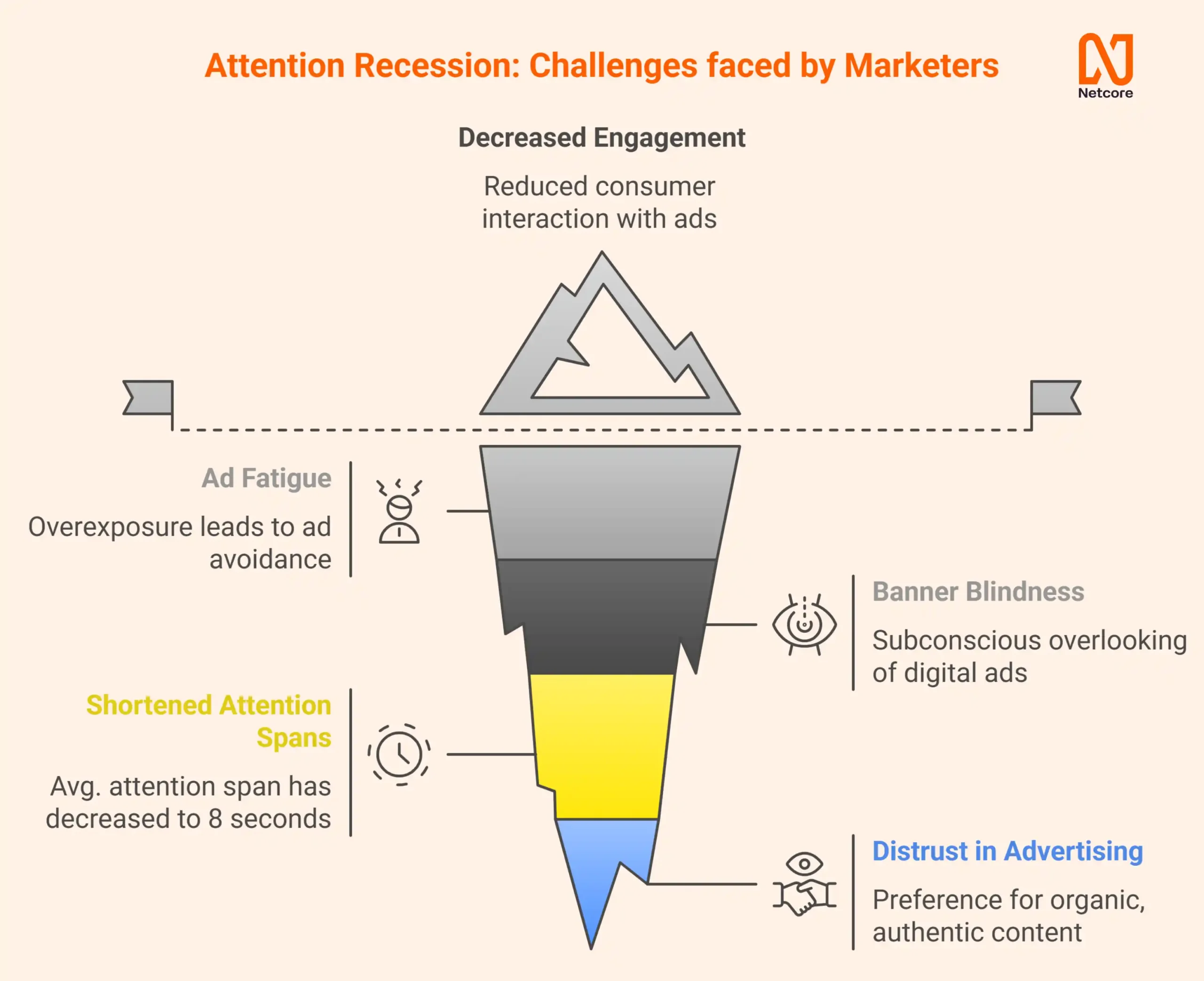
Marketing isn’t losing conversions. It’s losing attention. And the numbers are brutal: four out of five engaged customers disengage every quarter. The average click retention rate sits around 20%, yet most teams don’t even track it.
The Reality
Dashboards look “healthy” because they measure opens, clicks, and weekly conversions. But they miss the only question that predicts long-term profit:
Are the same people still engaging next month, next quarter, next year?
If you can’t answer that, you’re not measuring engagement. You’re measuring activity.
The Symptoms
- You don’t know which Best customers are quietly slipping into Rest
- You can’t define your attention half-life (how fast engagement decays)
- You can’t tell how much engagement typically happens before a purchase
How Agentic Marketing solves it
Agentic systems stop treating attention like a campaign metric and start treating it like an asset. They help you own relationships instead of renting attention, by building what I call Attention Bridges:
- Build a retention engine on first-party data (so you’re not dependent on auctions)
- Shift growth to owned channels like email, SMS, WhatsApp, push
- Replace broadcasting with interactive experiences (two-way, responsive journeys)
- Deliver hyper-personalization that feels like N=1, not “Dear {First Name}”
- Track attention states in real time so Best, Rest, Test, Next shifts are visible early
When customers feel invited, not interrupted, marketing stops being a tax. It compounds.
And that’s the escape route from the Attention Recession: move from renting attention to owning relationships.
Problem 6: Replace Guesswork with Measurement
Most teams are drowning in data and still making decisions on vibes. As the saying goes: “We collect petabytes, but we act on megabytes.”
For example, you will face the “7-Day Segment Problem” all the time in your regular workflow. By the time data gets stitched, the list gets built, and the campaign finally goes out, the customer’s intent window has already closed. Retention stops being a system and becomes a lottery.
The Symptoms
- Segments arrive late, so “real-time marketing” turns into “last week’s marketing.”
- Teams report activity (sends, opens) instead of outcomes (profit, repeat rate)
- You can’t tell which customers are growing in value and which are silently decaying
- Optimization becomes slow and reactive because the feedback loop is broken
Why is it impossible for humans
No human team can monitor millions of customers, detect micro-shifts in attention, and tie every interaction to economic value in real time. Dashboards lag. Reports get reviewed on Mondays. Customers churn on Tuesdays.
How Agentic Marketing solves it
Agentic systems make retention measurable at the customer level and act on it fast. Instead of vanity metrics, they run on a tighter set of “truth metrics” that connect behavior to value:
- Hooked Score: Depth and consistency of engagement
- Click Retention Rate (CRR): Whether customers who engaged last period still engage now
- Attention Churn Rate (ACR): How quickly relationships decay
- BRTN Transitions: Movement between Best, Rest, Test, Next cohorts
- Live Ledger: A real-time P&L view at the individual customer level
Together, these replace “we sent X emails” with “this customer generated $Y net value.” And that changes everything.
What gets measured becomes predictable. What becomes predictable becomes profitable.
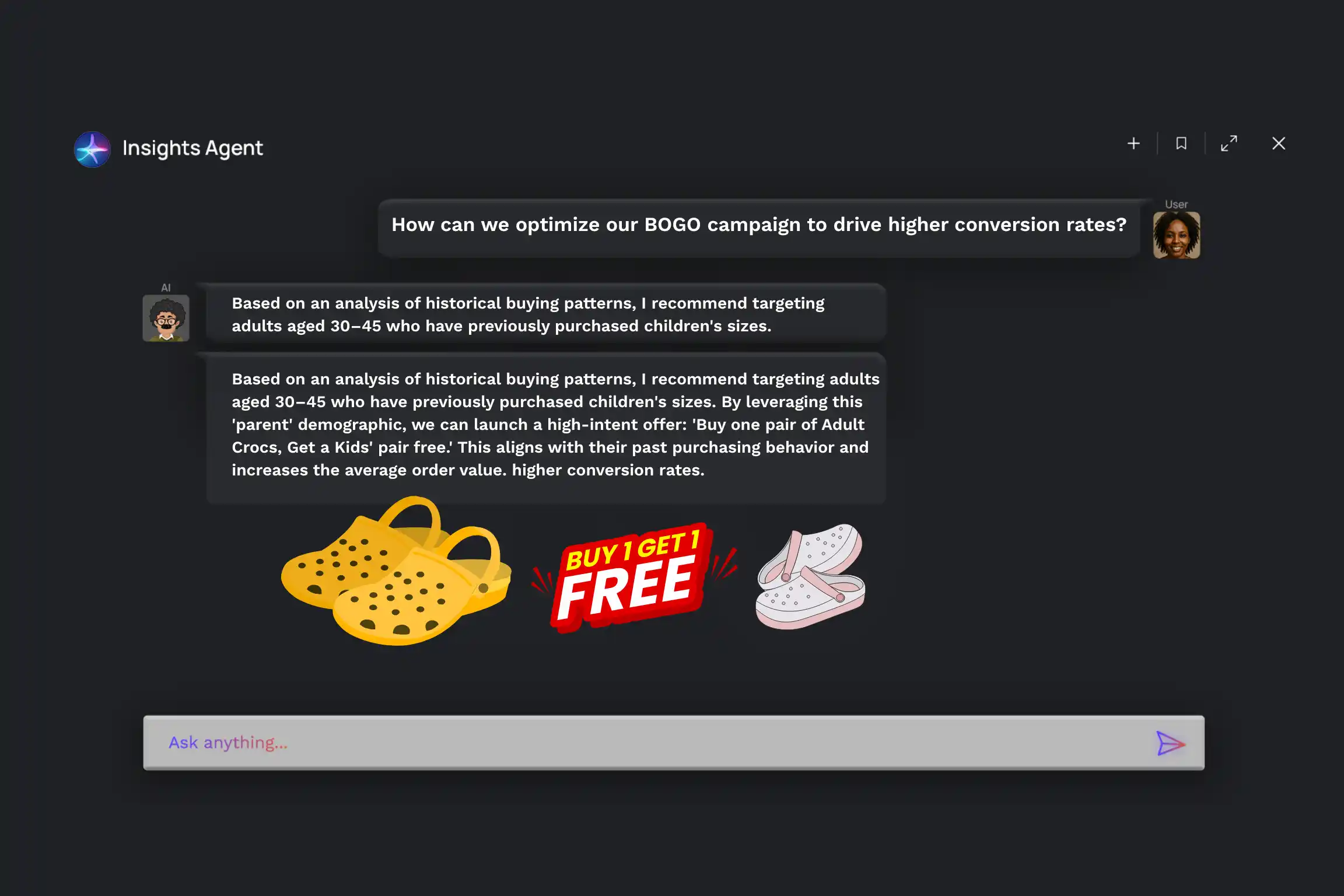
Netcore Insights Agent surfaces critical data immediately. It identifies the next-best action, the next-best product, drop-off predictions, and churn windows. It detects content fatigue signals and presents actionable insights in under 30 seconds. Netcore Cloud’s Insight Agent suggested a critical high-value insight to one of our clients, Crocs, ‘Middle-aged consumer most likely to parent plus kid combo’ in their BOGO sale. They were able to achieve 5 million incremental revenue from this sale and 10X ROI with the help of multi-agents. Read the full case study.
Problem 7: Bandwidth Issue
Walk into many marketing departments, and you will see a CRM team of three people trying to run campaigns that require the effort of thirty. 70% of a marketer’s time is spent on execution, managing technology rather than using it to make decisions.
Human constraints
The day is consumed by manual analysis, manual segmentation, manual journey updates, and manual creative rewriting. There is no time left for actual thinking.
The Agentic Advantage
Agentic systems provide 100x more segmentation and 25x faster campaign creation. Since 90 percent of the operational work is done autonomously, the human team is finally free to focus on what they do best, which is strategy and storytelling.
Problem 8: Martech Has Failed at Its Core Job
There is a universal reality in this industry. Every brand uses only about 30 percent of its Martech stack’s capabilities.
Why it happens
Tools have overlapping features and heavy UI complexity. There are simply too many buttons and too little bandwidth to push them. Most teams do not have the time to configure real-time decisioning engines.
The Agentic Fix
With an agentic approach, the agents work the tools for you. You do not need to learn a complex interface. The agents stitch data, generate creatives, run experiments, and optimize journeys without requiring human-triggered workflows.
Why Agentic Marketing Solves These “Impossible” Problems of Marketing
The difference between the past and the future is simple. Automation waits for instructions. Agentic systems decide the next-best action.
Rajesh Jain captures this perfectly when he says, “Success is simple. Eliminate ad waste.” Agentic systems do exactly that.
Modern marketing feels impossible because brands are stuck in a reacquisition loop—paying again and again to win back customers they already own.
Agentic Marketing breaks that cycle and replaces it with a retention engine powered by first-party data.
By combining AI, predictive segmentation, and real-time behavioral intelligence, brands can act the moment a customer shows intent (or signals potential dormancy). Every micro-interaction—an app open, a product view, a search, a wishlist—becomes a trigger for precision targeting.
This is not guesswork. This is N=1 personalization at scale.
Agentic Marketing eliminates the need for blanket discounts, reduces ad waste at the source, and protects margins by serving customers what they want—not what the brand hopes will work.
Here’s the startling reality most brands avoid saying out loud. Modern marketing has become a massive wealth transfer. You rent attention from ad platforms, pay again to “reacquire” customers you already earned, then bleed margin through discounts to make the numbers work. You are not just spending. You are subsidizing someone else’s business model. And yes, most teams are trapped in it.
The core mistake is structural: marketers keep measuring the crowd, not the customer. Cohorts. Segments. Averages. All comforting. All misleading. The only unit that actually matters is one individual customer. Economists call this “methodological individualism.” Marketers call it “too hard.” And that’s exactly why adtech keeps winning.
A new architecture for marketing (because the old one creates AdWaste)
You cannot end AdWaste using the same machinery that produces it. What you need is a shift from activity to compounding, from campaigns to systems:That shift does one thing most martech never promised: it turns marketing from a cost center into a compounding profit system.
Why Choose Netcore Cloud For Agentic Marketing
Netcore Cloud is the world’s first full-stack agentic marketing platform specifically for large-scale e-commerce, BFSI, and digital-first brands.
Unlike platforms that simply add AI features to old tools, Netcore is built on autonomous AI agents.
The Differentiators
- Predictive micro-segmentation that goes beyond basic demographics.
- True 1:1 personalization across email, app, WhatsApp, web, and push.
- Real-time orchestration of journeys that adapt on the fly.
- A Shopping Agent that enables commerce directly inside the inbox.
- Outcome-based pricing rather than pricing based on usage.
The results speak for themselves. Brands like Pomelo have seen a 30 percent conversion lift, and Fortune 500 brands rely on Netcore for 99 percent deliverability.
Final Take
The real promise of Agentic Marketing is simple: it solves the problems that outgrew humans.
It delivers something marketers have chased for decades but could never achieve at the same time—scale and relevance. Brands that make this shift now will spend less to acquire, retain more effortlessly, and eliminate the silent tax of wasted impressions and inefficient campaigns. They’ll stop stitching together isolated AI tools for segmentation here, an insight there, a content tweak somewhere else.
When agents operate as one system, they act in real time instead of waiting for instructions. They can sense intent, predict outcomes, trigger the next best move, and orchestrate an entire customer journey with the precision and speed humans were never built for.And if you’re ready for your marketing to stop reacting and start anticipating, it’s time to build that agentic marketing system with Netcore. Talk to us and get to know how.

