





Let’s Analyze How AI Shopping Assistants Are Transforming Ecommerce
- What an AI shopping assistant is: what it does, how it works, and where it fits in the ecommerce journey.
- AI shopping assistants vs. chatbots: the real differences in autonomy, context, and conversion impact.
- Benefits that matter: how assistants reduce decision friction and lift conversion, AOV, and retention.
- Use cases you can deploy today: practical ecommerce flows that drive measurable outcomes.
- Implementation pitfalls: the common challenges that quietly kill ROI (and how to avoid them).
- How to choose the right software: a checklist to pick a shopping assistant that fits your stack and goals.
Ecommerce has a quiet crisis.
Shoppers have more choice than ever, but less patience than ever. Your catalog keeps growing. Your product pages keep getting better. Your ads keep getting more expensive. And yet… customers still bounce because they cannot decide.
That’s the twist nobody wants to admit: conversion is no longer a “findability” problem. It’s a decision-making problem.
For years, we optimized discovery with cleaner filters, smarter search, and more personalized grids. That helped. But it assumes the shopper knows what they want and how to find it. Most don’t, especially in high-consideration categories like electronics, skincare, and home appliances, where specs are dense, use cases vary, and comparisons are not straightforward.
Now the market is responding as per what McKinsey says on the future of agentic commerce. Perplexity rolled out an agentic shopping feature, “Buy with Pro,” and OpenAI has been pushing agent-style task automation (including Operator) while also moving ChatGPT toward shopping experiences. Shopify is also building commerce plumbing like “Universal Cart” and catalog-style capabilities to make agent-led shopping possible across stores.
This is where AI shopping assistants change the game. Not as glorified chatbots, but as agents that guide discovery, reduce cognitive friction, and help shoppers reach a confident decision faster.
In this guide, I’ll walk through what AI shopping assistants are, how they differ from chatbots, why they’re working in today’s agentic marketing industry, what can go wrong, and how to choose one that actually improves revenue.
What is an AI-powered Shopping Assistant?
An AI-powered shopping assistant is a goal-driven system that helps shoppers decide faster, not just browse faster. As commerce evolves beyond the human-readable web, agents stand to become a primary interface between users and marketers, fundamentally transforming how consumers interact with products and services.
Instead of forcing customers to filter their way through hundreds of SKUs, it:
- Understands intent from natural language queries
- Advises like a helpful in-store associate
- Refines recommendations based on constraints and feedback
- Improves over time by learning from outcomes (clicks, add-to-carts, purchases, returns)
A shopper can type:
“I need a formal jacket under $150 that works in tropical weather.”
A real AI shopping assistant doesn’t respond with a FAQ link or a generic list. It interprets the request, selects relevant attributes (fabric, breathability, occasion), narrows the catalog, compares options, and recommends a few best fits. Then it helps the shopper choose.
Netcore’s AI Shopping Assistant
Netcore’s AI Shopping Assistant is built for enterprise-scale retail where guided discovery has to work across massive catalogs, fast-changing inventory, and varied shopper intent.
The “agentic” advantage here is that it combines:
- Language understanding (interprets messy, real queries)
- Catalog + product intelligence (structured attributes, specs, rules)
- Behavioral context (views, comparisons, exits, drop-offs)
- Real-time decisioning (adapts recommendations instantly)
The outcome is simple: shoppers stop guessing, start deciding.
AI Shopping Assistants vs. Chatbots: What’s the Difference?
This is where a lot of ecommerce teams get misled.
A chatbot can be useful. But it usually answers questions. It does not solve the underlying decision friction.
An AI shopping assistant solves an outcome.
Here’s the practical difference:
- Chatbot: “I want to return the laptop I got 2 days ago. Guide me on how I can get a refund or replacement.” → gives a link to the return policy.
- AI shopping assistant: “I need a durable laptop for a college freshman.” → asks a clarifying question, compares options, checks stock, finds deals, recommends a best fit.
The mental model that helps
Think of chatbots as customer service shortcuts. Think of AI shopping assistants as decision accelerators.
Chatbots help you respond. Shopping agents help customers choose.
Companies have spent decades refining consumer journeys, fine-tuning every click, scroll, and tap. But in the era of agentic commerce, the consumer no longer travels alone. Their digital proxies now navigate the commerce ecosystem, making millions of microdecisions daily. To thrive, brands must rethink the full stack of engagement—not for the people they’ve worked to understand but for the agents now acting on their behalf.
The Benefits of AI Shopping Assistants
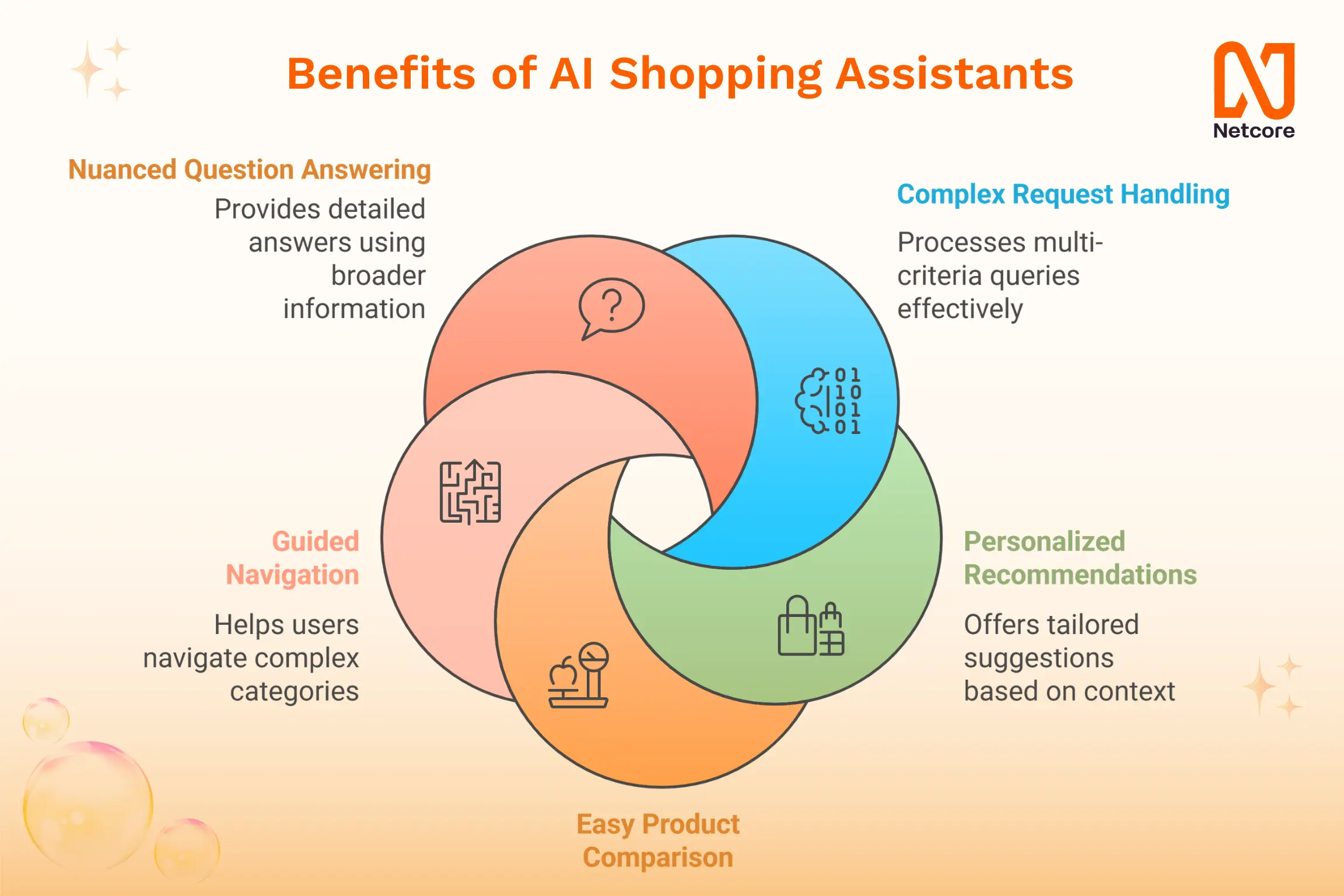
AI shopping assistants matter because they can do a set of jobs that traditional ecommerce tools struggle with or simply cannot do at all. That’s the difference between “a nicer chatbot” and a real Shopping Agent that moves conversion.
Here are the benefits that show up in practice:
- Understands complex, multi-criteria requests
Traditional filters break when shoppers describe needs like a human (budget + use case + style + constraints). A Shopping Agent can handle multi-faceted queries in one go and still keep the logic intact. - Delivers personalization from conversation context
The conversation itself becomes the context. As the shopper reacts, the agent refines recommendations in real time. With RAG (retrieval-augmented generation), it can also pull specific details relevant to that exact interaction, making the recommendations even sharper. - Makes product comparisons easy and digestible
Instead of forcing shoppers to open 10 tabs, the agent can compare products on the attributes that matter, and summarize differences clearly. It can also fetch details on demand when comparisons need more depth. - Guides shoppers through complex categories
In technical categories (electronics, appliances, skincare), the problem is cognitive load, not navigation. A Shopping Agent simplifies the decision by surfacing the key attributes, explaining trade-offs, and keeping the shopper focused on what matters. - Answers nuanced questions using broader product information
A strong agent is not limited to the standard product feed. It can tap into richer sources like manuals, long-form descriptions, and unstructured documents to answer specific questions that would otherwise lead to doubt, exits, or returns.
And this is the real business payoff: in an online world full of “analysis paralysis” and cart abandonment, Netcore’s AI Shopping Assistant helps shoppers decide faster and more confidently, which typically translates into higher conversion rates and fewer stalled journeys.
Virtual Shopping Assistant Use Cases: Ecommerce examples you can deploy
Here’s where this becomes practical. These are the use cases I see creating the most leverage.
Use case 1: Guided product discovery on category pages
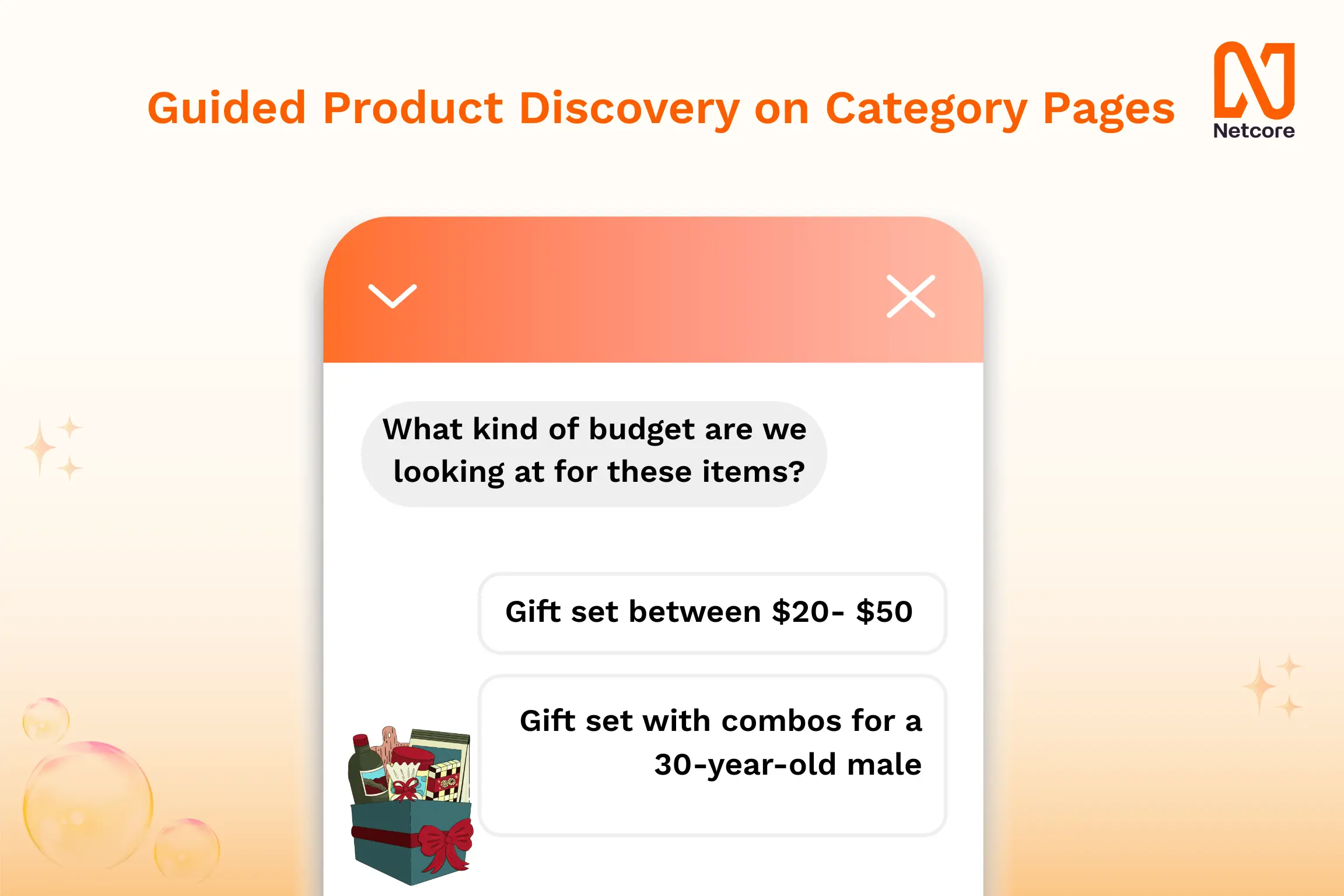
Instead of forcing shoppers to filter, the assistant starts with questions like:
- “Any specific budget you are looking for products?”
- “What’s your primary purpose of using laptop?”
- “Any deal-breakers in product type?”
Best for: electronics, skincare, appliances, furniture.
Use case 2: Comparison assistant for “shortlisted” products
If shoppers have 2–3 items open in tabs, they are already close.
An assistant can:
- Compare specs side-by-side
- Translate technical specs into outcomes
- Recommend the best fit based on stated preferences
Best for: phones, laptops, and home appliances.
Use case 3: Real-time help at “stall points”
This is where most brands lose revenue.
The assistant appears when behavior signals uncertainty:
- Repeated spec checks
- Multiple visits to the shipping page
- Long dwell time without add-to-cart
- Returns policy hover
Then it helps resolve doubt before exit.
Use case 4: Cart abandonment rescue with context
A generic reminder is not a rescue.
An assistant can infer why the shopper abandoned and respond accordingly:
- If they checked shipping 3 times: offer shipping reassurance or threshold-based free shipping
- If they compared prices: offer a price match or highlight value add
- If they browsed alternatives: reframe recommendations based on constraints
Use case 5: Post-purchase assistant for onboarding and support
The assistant continues after purchase:
- setup guides
- care instructions
- replacement/refill reminders
- cross-sell based on actual usage cycle
This is where retention starts.
The Challenges of Implementing AI Shopping Assistants
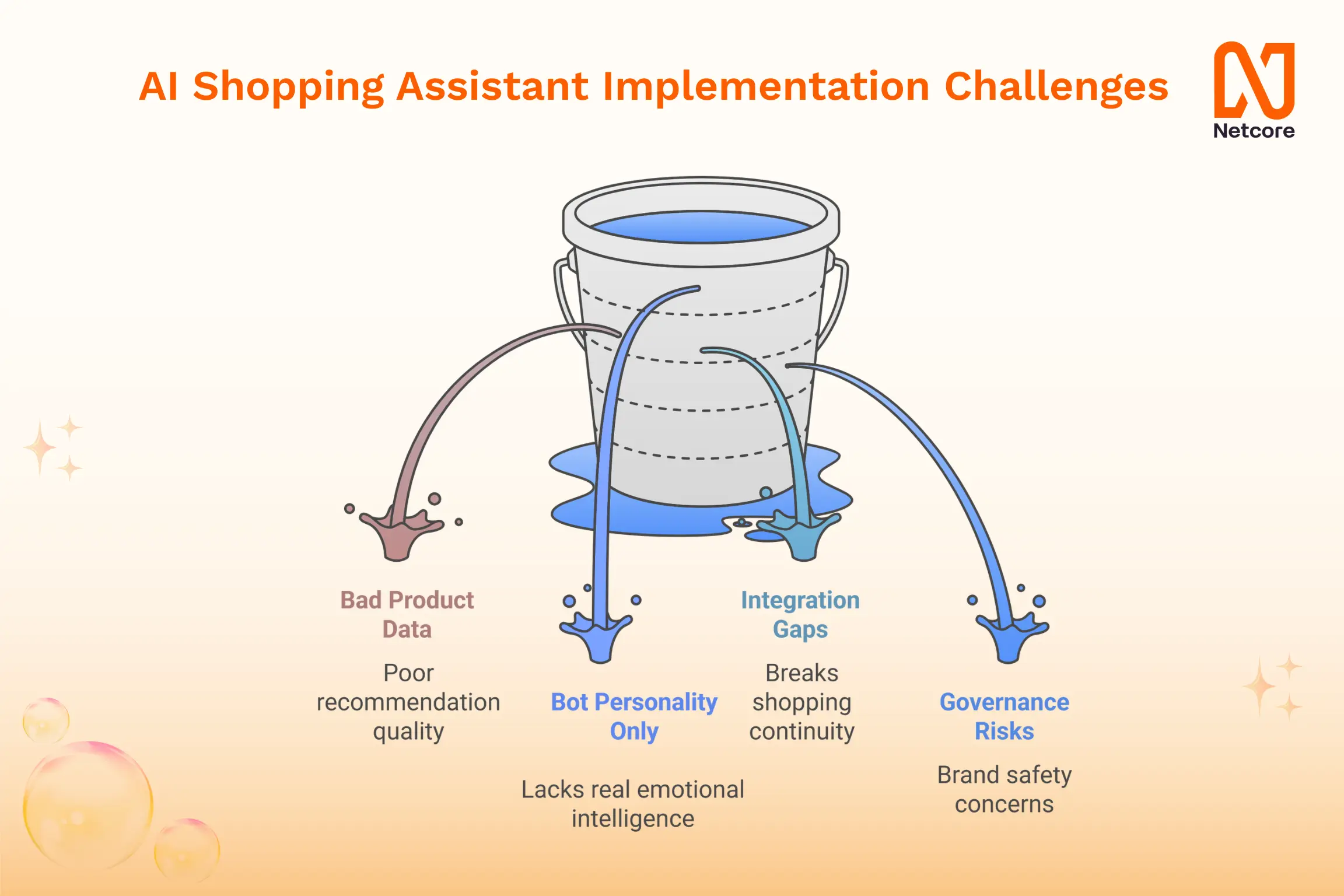
AI shopping assistants can also flop. Usually for predictable reasons.
1) Bad product data means bad recommendations
If your catalog attributes are inconsistent, incomplete, or messy, the assistant will produce:
- irrelevant recommendations
- confusing comparisons
- low trust
Fix: treat catalog data like a product. Maintain it.
2) “Bot personality” without actual intelligence
Some implementations focus on tone instead of outcomes.
You get a friendly assistant who cannot guide a decision.
Fix: measure success by conversion impact, not chat satisfaction.
3) Integration gaps kill continuity
If the assistant cannot access:
- inventory
- pricing
- promotions
- order status
- CRM preferences
It becomes shallow. Fix: deep integration with core systems matters more than UI polish.
4) Governance and brand safety risks
Assistants can hallucinate, misstate policy, or recommend wrong-fit items.
Fix:
- constrain outputs using product metadata and rules
- Include human review loops for sensitive categories
- Add guardrails for policy and compliance
Choosing the Right AI-Powered Shopping Assistant Software
This is the checklist I’d use if I were buying.
1) Can it handle real intent, not scripted flows?
Ask for examples of:
- open-ended queries
- ambiguous requests
- multi-constraint shopping
2) Does it integrate deeply with your commerce stack?
Look for:
- product catalog ingestion
- pricing and promotions
- inventory and availability
- CRM/CDP signals
- order management and support systems
3) Is it built for enterprise scale?
You want:
- fast response times
- stability under traffic spikes
- governance controls
- analytics tied to outcomes
4) Can it learn from outcomes?
A strong assistant improves by learning what led to:
- add-to-cart
- purchase
- churn/return
5) Does it support Answer Engine Optimization (AEO)?
For years, ecommerce optimization focused on cleaner filters, smarter search, and more personalized grids. But all of those assume one thing: that the shopper knows what they want and how to find it.
Most don’t. Especially in high-consideration categories where specs are dense, use cases vary, and comparisons are hard.
This isn’t just UI friction. It’s cognitive friction.
Solving that takes intelligence, not just design.
The role of AI-powered shopping agents
AI-powered shopping agents shift ecommerce from browsing to guided discovery. They are not chatbots with scripts. They are systems built on language models, product data, and behavioral signals.
They win on three capabilities:
- Understanding: interprets nuanced queries in plain language
- Advising: guides decisions, not just information retrieval
- Improving: learns from interactions and outcomes over time
This turns shopping from a guessing game into a goal-driven dialogue.
The rise of Answer Engine Optimization (AEO)
As conversational agents take over discovery, visibility is no longer only about ranking in search results.
The new competition happens inside AI ecosystems where assistants decide what to recommend.
That’s AEO.
AEO focuses on:
- structured product metadata
- schema markup
- clarity and context
- conversationally useful content
Retailers need to be discoverable not just on Google or marketplaces, but within AI-driven environments like assistants and agents.
Netcore’s AI Shopping Assistant is designed with this in mind, ensuring a brand’s catalog is not only indexed but contextually aligned with AI-led discovery and recommendations.
Final Take
If you’re still treating an AI shopping assistant as a “nice-to-have,” you’re not being cautious, you’re being late.
Because this isn’t just chat layered onto ecommerce. It’s a structural shift in how people decide.
The old model forced customers to do the heavy lifting: browse, filter, compare, second-guess, until fatigue made the decision for them. The new model flips the burden. Customers describe the outcome they want, and the system does what great retail has always done at its best: listen, narrow the field, explain the tradeoffs, and guide them to the right choice with confidence.
That’s agentic commerce.
And yes, there’s a hard business edge to it.
When you guide decisions instead of just displaying options, conversions go up because uncertainty goes down. Cart abandonment drops because the assistant resolves the silent deal-breakers in the moment—size confusion, compatibility doubts, delivery anxiety, “is this worth it?” hesitation, before customers bounce. And revenue climbs because you’re no longer relying on customers to “find more”; you’re proactively steering them to the right bundle, the right upgrade, the right alternative when something’s out of stock—without feeling pushy.
The brands that win won’t be the ones obsessing over page tweaks.
They’ll be the ones engineering outcomes, optimizing decisions, not just pages—and turning intent into revenue while competitors are still redesigning filters.
If you want to explore what this looks like at enterprise scale, Netcore AI Shopping Assistant is one of the clearest examples of how guided discovery becomes measurable growth. Talk to us.

