




The next generation of marketing leaders will blend human creativity with AI autonomy. To win in an agentic era, CMOs must evolve from managing teams to orchestrating intelligent systems — where AI agents handle execution, and humans focus on strategy, ethics, and brand narrative.
Imagine you tell your marketing team, “Let’s launch the new campaign.” Normally, that would trigger chaos — data pulls, creative requests, frantic Slack messages.
But this time, just an hour later, your team walks back in: calm, composed, and says, “It’s live.”
You’re stunned.
What used to take days or even weeks, like audience segmentation, creative testing, and orchestration, happened almost instantly.
That’s the power of agentic marketing.
Netcore Agentic Marketing now handles the heavy lifting, building segments, generating content, and optimizing journeys, all while your team focuses on strategy, storytelling, and brand direction.
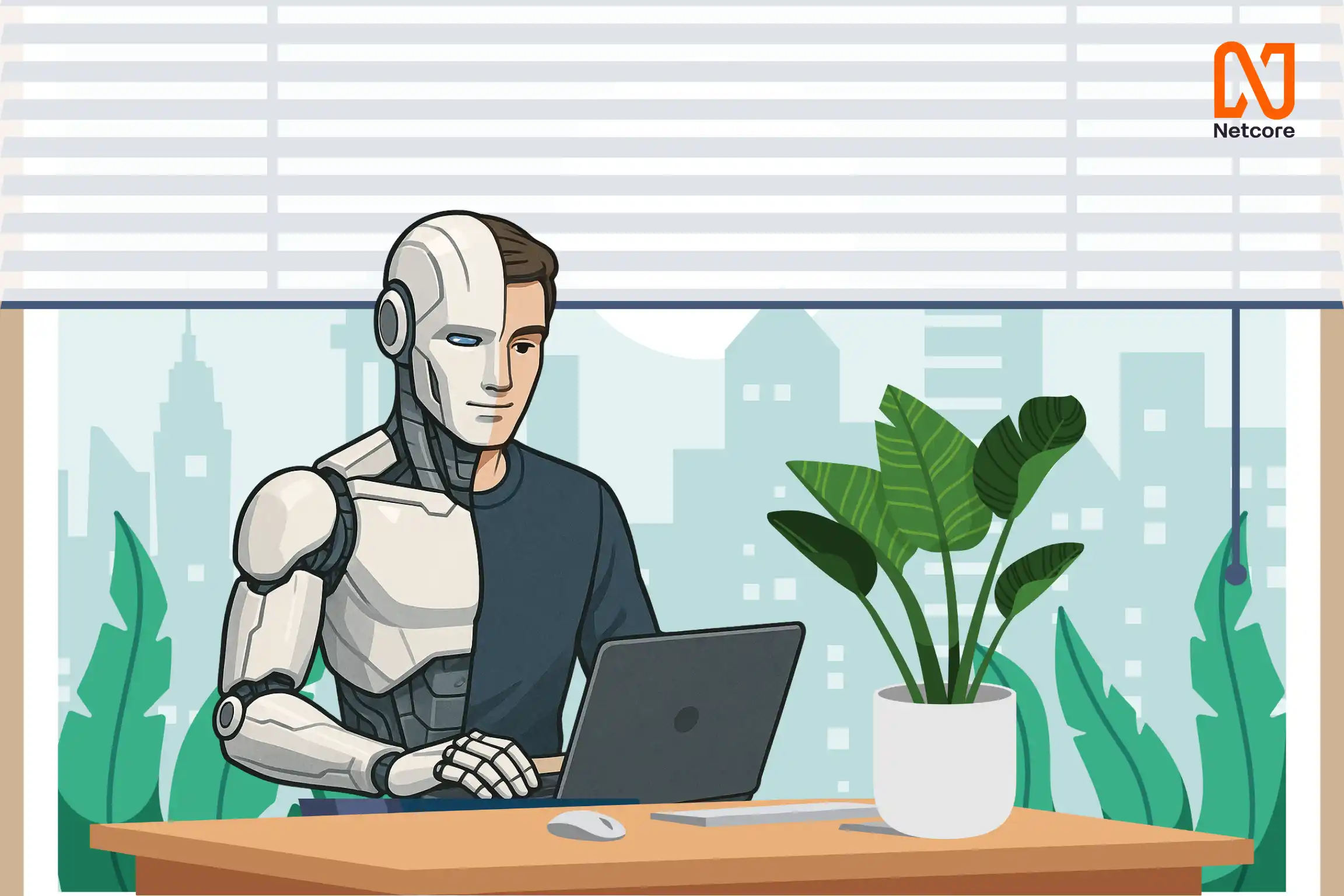
Because agentic marketing isn’t about removing people; it’s about removing the repetitive work so marketers can think bigger. The next great marketer won’t be human or machine; they’ll be half human, half agent.
The Human + Agent Revolution: Redefining Roles
For decades, marketing technology promised scale, more campaigns, more channels, more data. But what it really created was complexity. Teams were buried under dashboards and deadlines, not strategy.
Agentic marketing flips that equation.
It redefines the relationship between humans and machines, turning AI from a passive assistant into an active collaborator. According to Gartner, agentic AI will autonomously make over 15% of daily work decisions by 2028.
Here’s the truth:
Agentic marketing isn’t about taking people out of the equation — it’s about taking people out of the routine.
Day-to-day execution, like testing, iterating, and optimizing, will increasingly be handled by autonomous AI systems that can learn and act faster than any team could.
Meanwhile, marketers will move higher up the value chain — shaping brand narratives, directing creative ideation, and thinking through the ethical implications of automation.
In this new model, humans define the “why” agents deliver the “how.”
It’s not a replacement; it’s amplification.
Because when humans lead with intent, and agents execute with precision, marketing finally becomes what it was always meant to be: intelligent, agile, and deeply human.
From Automation to Autonomy: The Next Leap
Automation was a revolution; it helped marketers send more emails, launch more campaigns, and scale outreach. But it also created a new bottleneck: human dependence.
Every workflow still needed a manager. Every change still needed approval. Every insight still had to be acted on manually.
That’s where the next leap in autonomy begins.
Agentic marketing is the bridge between automation and autonomy.
Instead of waiting for instructions, AI agents act on intent. They don’t just automate tasks; they own outcomes.
When an AI system can identify behavior shifts, predict intent, and adjust journeys without human intervention, that’s not automation — that’s intelligence in motion.
Think of it as the difference between cruise control and autopilot.
Cruise control keeps you at a speed.
Autopilot gets you safely to your destination — adapting, learning, and correcting along the way.
Agentic systems work the same way. They don’t just follow workflows; they evolve them.
- The Segment Agent recalibrates your audiences in real time.
- The Content Agent creates copy and images in line with the brand voice.
- The Scheduler Agent picks the perfect time and channel for each user, creating various cohorts to send the campaign.
Meanwhile, your team focuses on the higher-order work — creative ideation, ethics, and long-term brand vision.
Because in this new era, the most powerful marketers aren’t the ones who work faster. They’re the ones who’ve learned when to let go.
The Human + Agent Workflow in Action
| Function | Agent Type | What the Agent Does | Human + Agent Workflow |
|---|---|---|---|
| Audience Intelligence | Segment Agent | Creates dynamic, evolving micro-segments based on 500+ behavioral, affinity, and propensity data points. | Human: Defines campaign goals (e.g., “increase repeat purchases”). Agent: Builds segments automatically and updates them as behaviors shift. Human: Validates and adjusts targeting strategy based on results. |
| Content Personalization | Content Agent | Generates adaptive creatives and messaging for each audience segment in real time. | Human: Sets tone, brand voice, and guidelines. Agent: Produces and tests personalized content variants autonomously. Human: Reviews winners and locks successful themes for future campaigns. |
| Campaign Orchestration | Scheduler Agent | Determines best channel and time per user via send-time optimization and channel preference data. | Human: Defines communication priorities (e.g., “push first, email backup”). Agent: Executes timing and sequencing autonomously with fatigue management. Human: Monitors performance and adjusts engagement strategy as needed. |
| Product Discovery & Commerce | Shopping Agent | Suggests, bundles, and upsells products in real time within inbox, app, or chat. | Human: Sets merchandising goals and promotions. Agent: Recommends and adapts based on inventory, context, and user intent. Human: Reviews analytics to refine product strategy. |
| Optimization & Learning | Insights Agent | Surfaces actionable insights, predicts next-best actions, and recommends experiments. | Human: Interprets insights and validates predictions. Agent: Tests hypotheses automatically, closing the loop between insight and execution. |
Why Human Creativity Still Wins
AI can write. It can optimize. But it can’t imagine!
When AI agents handle execution, testing, and optimization, marketers finally get to do the one thing no algorithm can: create meaning.
“AI can generate a message; only humans can give it meaning.”
“AI can optimize a journey; only humans can define the destination.”
Picture this: a creative strategist defines a bold campaign theme. Within hours, AI agents have tested hundreds of tone, image, and copy combinations — finding what resonates across audiences and channels.
When marketers use AI to automate and accelerate repetitive or analytical tasks, they free up more time for creative brainstorming, strategic direction, and refining ideas.
The ROI Revolution: Reducing Ad Waste with Agentic Systems

In his interview with Social Samosa, Rajesh Jain, Founder of Netcore, captured the truth every CMO knows but rarely admits:
“Success, to me, is simple. It’s about eliminating ad waste. Today, nearly 70% of marketing budgets are spent reacquiring the same customers instead of retaining them. That’s pure waste.”
Netcore’s Agentic Marketing Platform flips that equation.
Instead of chasing the same audience over and over, AI agents predict what customers want next — and engage them before they drift away.
Every dollar stops shouting and starts compounding.
Spend flows where it creates value — personalized journeys, predictive retention, and meaningful growth.
The result? Lower CAC. Higher ROI. Zero waste. Get informed on the statistics of Ad waste on Brand Equity.
Building the Foundation of an Agentic Marketing Organization
You can’t run before you learn to orchestrate.
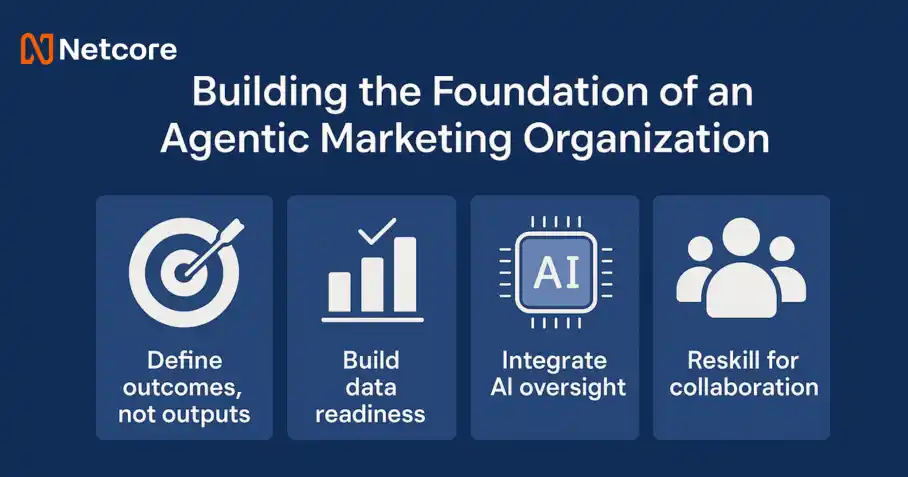
Here’s how to start architecting your hybrid human-AI marketing ecosystem:
- Define outcomes, not outputs.
Tell your agents what success looks like — not what tasks to perform. - Build data readiness.
Unified, clean data is the raw material for accurate predictions and instant personalization. - Integrate AI oversight.
Set ethical guardrails, testing loops, and human checkpoints.
The best systems are self-learning, but never self-governing. - Reskill for collaboration.
Train teams to think like strategists and orchestrate like conductors — directing insights, not just executing tactics.
Agentic organizations aren’t just more efficient; they’re more accountable with Netcore Agentic Marketing.
Every action, every optimization, every outcome — traceable, measurable, improvable.
Final Take
The next great marketer won’t compete with AI — they’ll collaborate with it.
They’ll be part strategist, part storyteller, part system designer — leading an ecosystem of autonomous agents that learn, adapt, and scale success.
Those who embrace this human-plus-agent model today won’t just survive the next wave of marketing transformation. They’ll define it!
Because in the end, the future of marketing isn’t human or machine.
It’s human through machine.
Ready to build your hybrid marketing team of the future?
Talk to Netcore, and start working with AI agents that think, act, and scale your success autonomously.

