





Let’s face it — most marketing teams are still running playbooks built for a pre-AI world. Automation had its glory days. It helped us move faster, send more, and scale. But it’s reached its ceiling — it executes, it doesn’t think.
Meanwhile, customers have evolved. They don’t want rule-based campaigns; they expect brands to sense, predict, and adapt instantly — no lag, no friction.
That’s where agentic marketing comes in. These AI-native systems don’t wait for commands; they act with intent. They perceive behavior, anticipate needs, and orchestrate personalized journeys in real time. It’s the leap from automation to autonomy — from doing what you say to figuring out what to do next.
For CMOs, this isn’t some far-off vision of the future. It’s here now. And the shift isn’t optional.
The companies that apply agentic principles today will:
- Run leaner, more adaptive marketing teams.
- Build deeper, more profitable customer relationships.
- Escape the treadmill of spending more to acquire customers they’re already losing.
That’s why in this article, I’ll break down the 7 agentic marketing principles every CMO can put into practice today — not theory, not hype, but actionable strategies you can apply to your team right now.
7 Principles of Agentic Marketing
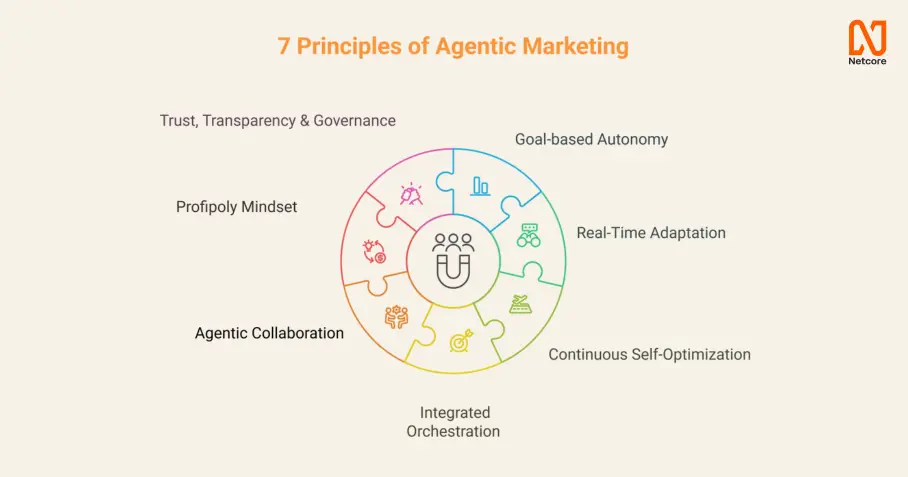
1. Goal-Based Autonomy
Agents don’t wait for instructions—they work toward defined business outcomes and adapt along the way.
Think of it like hiring a growth-minded intern who never sleeps, never forgets, and keeps improving week after week. You don’t micromanage; you set a goal, and they figure out the best path to get there.
- In marketing, that goal might be to increase reactivation by 15% or raise average order value by $20.
- The agent then runs endless micro-tests, learns what works, and adapts on the fly.
- Your role as CMO? Define the outcomes, set guardrails, and audit performance.
Example: Intercom’s Fin is a great illustration—it charges per resolved issue, not per seat. That’s goal-based autonomy in pricing and performance.
2. Perception and Real-Time Adaptation
Agents don’t just follow a script—they perceive signals from customer behavior and adapt instantly.
This is where agentic systems pull away from traditional automation. While automation waits for a pre-set rule (“send email X when cart is abandoned”), agents perceive nuances in real time—like a sudden drop in engagement or a surge in interest in a new product line—and act accordingly.
- They analyze signals across channels simultaneously: web, app, WhatsApp, and email.
- They don’t wait for end-of-week reporting—they adapt campaigns in the moment.
- They balance relevance with timing, making personalization feel effortless.
Examples:
- Spotify’s Discover Weekly adapts to your tastes every Monday, trained on your real behavior.
- Tesla’s Autopilot perceives the environment in real time and makes micro-adjustments—marketing agents should behave the same way.
3. Continuous Self-Optimization
Let agents run perpetual micro-tests and optimize in real time. Marketing becomes a living system, not a campaign calendar.
Traditional marketing is like setting up a fireworks show: plan for weeks, launch, admire briefly, and start over. Agentic marketing is more like tending a garden—it keeps growing, adapting, and producing with constant care.
Real-world inspiration:
- Amazon’s recommendation engine has been evolving for over 20 years. Today, it drives 35% of the company’s revenue because it’s always learning and improving.
Putting it into practice:
- Deploy AI agents that can automatically test subject lines, timing, or offers.
- Move away from “big-bang” A/B tests → adopt continuous, rolling optimization.
- Reframe your team’s role: they don’t set up every test—they audit the learning process and steer the strategy.
The more you let agents self-optimize, the more compounding gains you unlock. It’s like compound interest, but for marketing.
4. Integrated Orchestration
Agents don’t work in silos—they collaborate as a collective, orchestrating end-to-end journeys across the stack.
The magic happens when specialized agents work together like a pit crew in Formula 1. Each has a role, but the victory only comes when they coordinate seamlessly.
- Insights Agent spots a churn risk.
- Segment Agent builds a predictive micro-segment.
- Content Agent crafts the right personalized message.
- Shopping Agent delivers the offer and closes the loop.
This is exactly how Netcore’s AI Agents collectively work—modular, collaborative, and outcome-focused. Instead of juggling tools, teams orchestrate outcomes across the funnel.
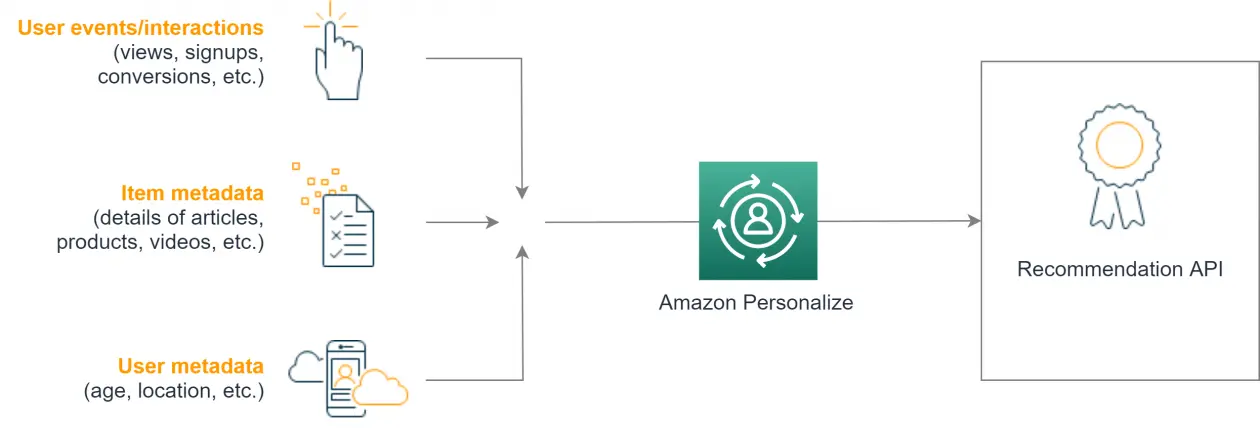
Example: Amazon’s recommendation engine has been doing integrated orchestration for years, threading together browsing, purchase, and search signals to create one fluid shopping experience that drives 35% of its revenue.
5. Agentic Collaboration
Deploy specialized agents that work together seamlessly. Your role as CMO is to orchestrate outcomes, not workflows.
Here’s the mindset shift: you don’t need one “super-agent” that does everything. You need a collective of specialized agents, each doing their part and passing the baton.
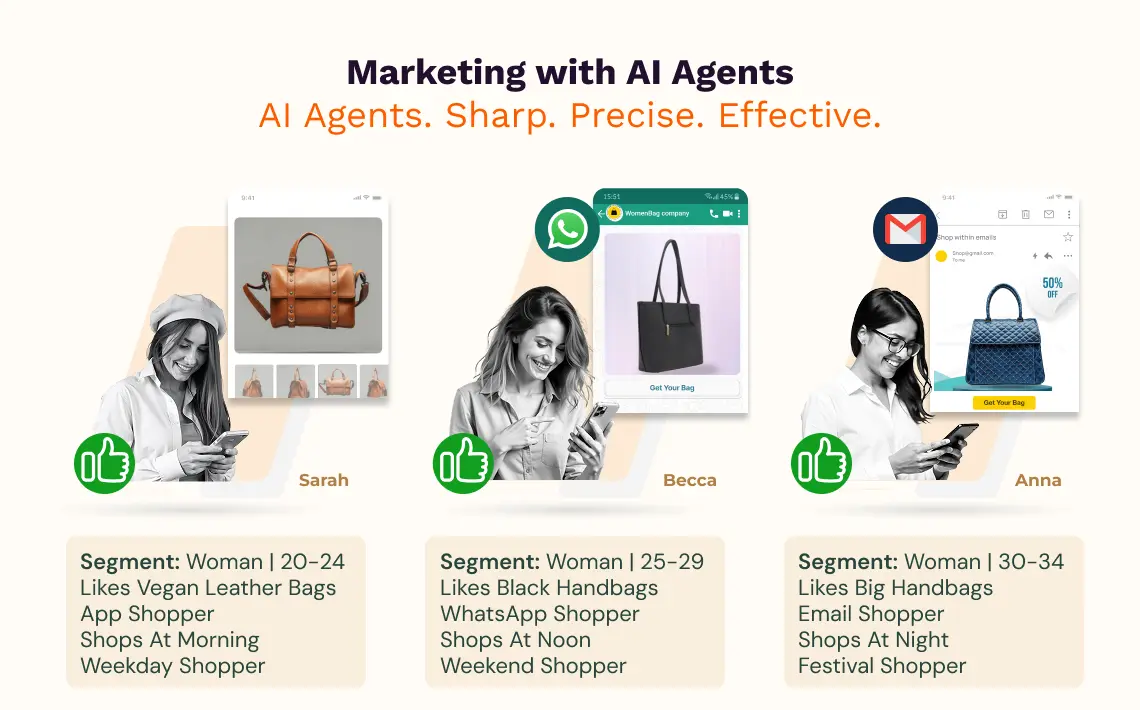
Virtual representation of how working with AI agents for segmenting users looks like.
What this looks like:
- Insights Agent → uncovers hidden opportunities in customer data.
- Segment Agent → builds predictive micro-segments.
- Content Agent → generates and optimizes personalized messages.
- Shopping Agent → recovers carts, upsells, and closes the loop.
This is exactly the model Netcore has operationalized with its world’s first Agentic AI marketing team. Instead of marketers managing dozens of disconnected tools, the agents collaborate in real time—leaving the team free to focus on strategy, governance, and creativity.
It’s not about doing more work. It’s about building an ecosystem where work gets done for you.
6. Profipoly Mindset
Use agentic models to solve the growth vs. profitability paradox. Marketing becomes a profit engine, not a cost center.
Every CMO knows the paradox: the more you spend to grow, the thinner your margins get. But cut acquisition costs, and growth stalls. It feels like physics.
Agentic marketing flips this script. By focusing on retention, reactivation, and loyalty uplift, CMOs can grow revenue and improve margins simultaneously.
Proof points:
- Adobe Experience Cloud case studies show personalization-led retention delivers higher ROI than raw acquisition. Read some examples here.
- Netcore’s ZeroBase pricing model aligns compensation with incremental revenue uplift, not activity, turning marketing investments into measurable profit for their clients that use Netcore’s AI-powered marketing automation software.
When agents continuously optimize engagement and reactivate dormant customers, you build what we call a “Profipoly”—a sustainable profit monopoly where your economics get stronger over time.
7. Trust, Transparency & Governance
Closing the AI readiness gap is as important as deploying the tech. Teams and customers need to trust the system.
This is the elephant in the room: AI anxiety is real. As Fortune recently reported, many employees use AI tools without proper training or consent. Only 44% of entry-level staff say they’ve received meaningful AI training. That’s a big readiness gap.
What CMOs should do:
- Be transparent about how agents will be used and what decisions they’ll make.
- Invest in training: give teams the skills and confidence to work alongside agents.
- Create guardrails: audit systems regularly, ensure explainability, and maintain a human override.
- Borrow a page from Salesforce, which publishes clear AI ethics principles to build trust with both employees and customers.
The future of agentic marketing isn’t just about algorithms—it’s about people trusting those algorithms enough to adopt them.
Core Components of an Agentic Framework
Now that we’ve covered the principles, let’s zoom out and look at the components you’ll need to put them into practice:
- Agents: task-specific specialists (Insights, Segment, Content, Shopping).
- Kernel: the central “brain” for engagement, orchestration, and attribution.
- Ecosystem: a marketplace where agents can be added, swapped, or upgraded.
- Measurement Layer: outcome-based attribution that ties marketing to revenue uplift, not just activity.
Think of it like building your own Formula 1 car: the agents are the parts, the kernel is the engine, the ecosystem is the garage, and the measurement layer is the telemetry.
Putting Principles into Practice: What CMOs Can Do Today
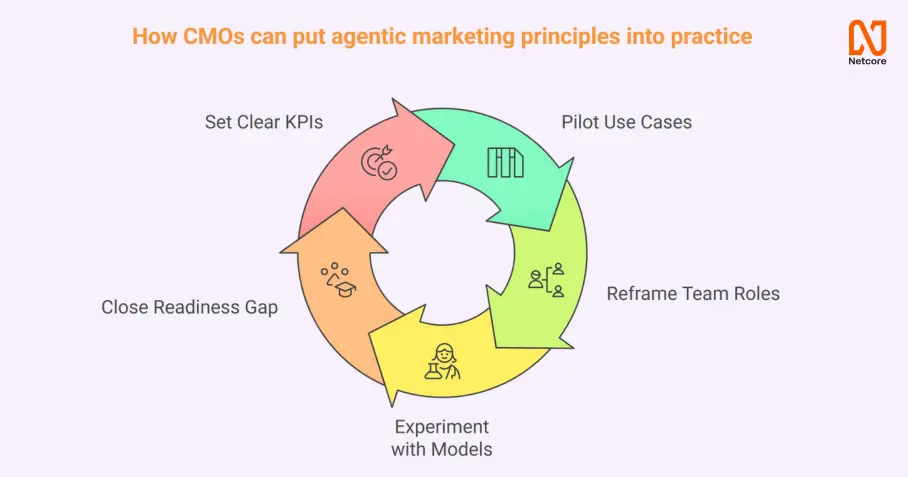
Feeling overwhelmed? Don’t be. The shift to agentic marketing doesn’t happen overnight — but it starts with deliberate, practical steps. Here’s a proven playbook you can act on right now:
- Pilot low-risk use cases: Start with areas that show quick, measurable ROI, such as cart recovery, churn prevention, or reactivating dormant customers. According to McKinsey, marketers who apply AI to these early-stage use cases see up to a 10–20% lift in conversion rates within months.
- Reframe team roles: Move your people from operators to strategists, auditors, and brand stewards. Gartner predicts that by 2026, 60% of marketing teams will have redefined job roles to focus on supervising and interpreting AI-driven outputs.
- Experiment with outcome-based models: Consider growth-linked partnerships such as Netcore’s ZeroBase, where you only pay for results, not promises. These performance-driven models align accountability directly with impact — a crucial mindset for agentic transformation.
- Close the readiness gap: AI transformation fails more often due to culture than technology. Train your team, communicate transparently, and build psychological trust.
- Set clear KPIs: Ditch vanity metrics. Track uplift, not activity. Measure outcomes like incremental revenue, engagement depth, and customer lifetime value (CLV) instead of just open rates or impressions. You should measure incremental revenue growth to understand the impact of the campaigns on a controlled user group.
You don’t have to go all-in on day one. Start small, prove value, and scale what works. That’s how agentic marketing moves from theory to advantage, one experiment at a time.
Conclusion
Agentic marketing isn’t just another buzzword. It’s a fundamental reset in how marketing is done, measured, and led.
As CMOs, our role is no longer to orchestrate campaigns—it’s to orchestrate outcomes. By embracing these seven principles, we can:
- Build marketing teams that are leaner, smarter, and more outcome-focused.
- Align incentives with growth and profitability.
- Earn daily customer attention, not just fleeting clicks.
- Position marketing as the profit engine it was always meant to be.
The future isn’t about buying more tools. It’s about adopting principles that turn marketing into a self-optimizing, outcome-driven system.
And the best part? You don’t have to wait. These principles are actionable today.
So, the question is: will you let your team get stuck in automation’s past—or lead them into the agentic future? Our experts can show you exactly how to apply agentic marketing to your business today — and turn AI into your next growth engine. Talk to us.

