





Marketing leaders in 2026 are standing at a crossroads: deliver hyper-personalized, real-time customer engagement… with smaller teams, shrinking budgets, and an increasingly unpredictable consumer. The irony? Most are still relying on traditional automation systems built for a world that no longer exists.
All these years at Netcore, we have been speaking with CMOs and growth leaders across ecommerce, BFSI, travel, OTT, and marketplaces, and the story is eerily consistent. Their teams are drowning in workflows. Segments are multiplying like rabbits. Journeys break every time customer behavior shifts. And despite all the automation, campaigns still take days to launch.
The uncomfortable truth is this: automation was built for efficiency, not adaptability. And in a market that moves in real time, efficiency alone is not enough.
Which raises the real question:
Are you optimizing your current automation stack because it’s “what you already have”… or because it’s actually delivering the outcomes you promised your business?
If the answer gives you pause, you’re not alone. The next era of marketing won’t be led by systems that wait for instructions, but by agentic platforms that act on your behalf, reducing manual work, eliminating wasted spend, and pushing retention outcomes forward automatically.
Let’s break down what truly separates agentic marketing from traditional automation, and why the shift is no longer optional.
What Is Traditional Marketing Automation?
Marketing automation promised efficiency.
What it delivered instead, especially by 2026, is a strange hybrid of automation plus endless manual work.
Every marketer knows the truth:
Automation isn’t freeing teams…it’s exhausting them.
Before we define agentic marketing, we need to understand why the old model is starting to collapse under its own weight.
A. How Traditional Marketing Automation Works
Think of traditional automation as a series of pipes. You connect triggers, conditions, delays, and hope the water flows the way you planned.
The system works only when customers behave exactly as your journey diagram predicts, which they rarely do. I’d like to explain this better with the help of The Tale of Mark and the Marble Run Campaign (Pre-2024).
Imagine Mark, a sharp, dedicated marketer, tasked with launching a major customer acquisition campaign in 2024. He envisioned his campaign’s workflow like a grand, meticulously constructed marble run; every drop, every turn, every delay was planned down to the millisecond. This was the era of Traditional Automation, and Mark, like his peers, built his campaigns on three seemingly solid, yet ultimately brittle, pillars.
1. Predefined Workflows
Mark’s campaign began with Predefined Workflows.
Mark didn’t see customers; he saw a static flowchart. He spent days diagramming the perfect “journey” for a new sign-up:
“If a user completes Step X (Trial Sign-Up) → then Wait 48 Hours → then send Message Y (Feature A Intro) → If they don’t click, Wait 24 Hours → then send Message Z (Social Proof).”
He submitted this complex diagram, the series of pipes, to his automation platform, connecting the triggers, conditions, and delays. He crossed his fingers and hoped the “water” (the customer) would flow exactly as he’d planned.
The Problem: The system worked only if customers behaved like perfect, predictable little marbles. The moment a customer took an unexpected shortcut, lingered too long at a corner, or exited the track entirely, Mark’s journey instantly broke.
As customer behavior is not static. Journeys break as soon as behavior changes.
2. Static Segments
Next came the challenge of targeting, based on Static Segments.
Mark needed to know who to target. His workflow started with a crucial task: sending a request to the Data Team/Data Science Team: “Please give me a segment of all ‘High-Value Trial Users who haven’t engaged with Feature B in the last 7 days.'”
- Day 1 (10:00 AM): Mark sends the request.
- Day 2 (3:00 PM): The Data Team pulls the data, runs the script, and uploads the segment file.
- Day 3 (9:00 AM): Mark uploads the list to his marketing platform.
The Problem: That segment was already a day and a half old. A user’s critical behavior change from this morning, say, they just purchased the highest-tier plan, would not appear in Mark’s segment until tomorrow, or later. Mark was always aiming his sophisticated weaponry at where the target used to be.
3. One-Off A/B Tests
A/B tests are isolated events.
They don’t learn continuously. They don’t scale.
And they forget everything after the test ends.
In short:
Marketers decide → The system executes → Then marketers fix what the system missed.
While the data lag persisted, Mark worked in parallel with the Creative Team to execute the campaign launch. He meticulously finalized the images, videos, and copy for Message Y and Message Z, all the beautiful assets needed for his marble run.
Just as he got all the creatives ready and approved, a massive, game-changing industry trend or a viral topic rolls in.
The Problem: Mark sees the trend and knows he should adopt it—his competitors are already capitalizing! But he’s sunk hours and budget into his current pre-approved assets. His launch date is fixed. His creatives are baked. His system is programmed.
He is unable to adapt it. To change course now means halting the entire process, restarting the Creative Team’s work, and delaying the campaign by another week. He has to launch the old, less-relevant campaign.
Identifying the real culprit
The campaign launches. The marble run begins. As expected, customers start behaving like real people, not flowcharts.
Mark’s entire process boils down to a repeating, exhausting loop:
- Marketers Decide: Mark designs the static path.
- The System Executes: The automation runs the old plan.
- Then Marketers Fix What the System Missed: Mark spends the rest of his week reviewing reports, manually patching leaky segments, and setting up one-off, isolated A/B Tests that don’t learn continuously, don’t scale, and forget everything after the test ends.
In the world of traditional automation, Mark wasn’t a strategist; he was a triage engineer, constantly fixing the rigid pipes that couldn’t handle the dynamic flow of real-time customer behavior.
B. Where Automation Fails Marketers Every Day
Rajesh Jain’s words perfectly define the core marketing challenges faced by many brands today:
“Success is eliminating ad waste. Nearly 70 percent of marketing budgets go into reacquiring the same customers.”
Here’s where the story becomes painfully real for most teams.
1. “The 7-Day Segment Wait”
A marketer needs a hyper-specific segment:
- Viewed Product X in the last 48 hours
- Did not purchase
- Lives in CA or TX
- LTV above $500
In automation platforms, this is what happens next:
- Web analytics data is in one system
- CRM data in another
- LTV score in a CDP
- The marketing automation tool can’t query raw events
- Data teams scramble to stitch the query
- A CSV arrives 3-7 days later
Outcome: By the time the segment goes live, the 48-hour buying window is already dead.
Intent decays. Conversion drops. Opportunity is gone.
This is not automation.
This is latency disguised as process.
2. “The Campaign Pause for a Demographic Deep Dive”
A marketer sees a campaign tanking. Open rates dive. Clicks evaporate.
They suspect: “Maybe 18–24-year-olds aren’t responding.”
But automation tools can’t combine engagement + demographic data natively. So:
- Export data from the email tool
- Join with demographics from the CRM
- Rebuild a segment
- Pause the campaign
- Re-upload target lists
This takes a full day.
Meanwhile, the campaign keeps bleeding money or stays paused, missing revenue targets.
In a world of instant user behavior shifts, automation moves too slowly to save campaigns in real time.
3. The Brick Wall: “We Need Devs Again”
Marketers want to change:
- A journey condition
- A custom event
- A product feed
- A personalization rule
But traditional automation tools depend on backend teams.
Suddenly, the CRM team is filing Jira tickets for help with… marketing.
Journey updates become engineering projects.
Speed collapses.
Agility dies.
C. Strengths & Limitations
Strengths
- Works for predictable, repetitive tasks
- Ensures consistent messaging
- Good for simple lifecycle flows
Limitations (What Marketers Feel Daily)
- Brittle journeys break under real user behavior
- Segments update slowly
- Funnels don’t react dynamically
- Teams wait days for insight
- Campaigns can’t self-correct
- Every fix requires human intervention
Traditional automation was built for 2013. Not for 2026.
What Is Agentic Marketing?
Where automation follows instructions, agentic marketing operates with intent.
Agentic marketing is a new paradigm where AI doesn’t just assist the marketer—it acts on behalf of them.
A. Definition
Agentic marketing = AI agents that autonomously plan, decide, execute, and optimize campaigns toward a goal set by the marketer.
You no longer tell the system what to do.
You tell it what outcome you want.
B. How Agentic Marketing Actually Works
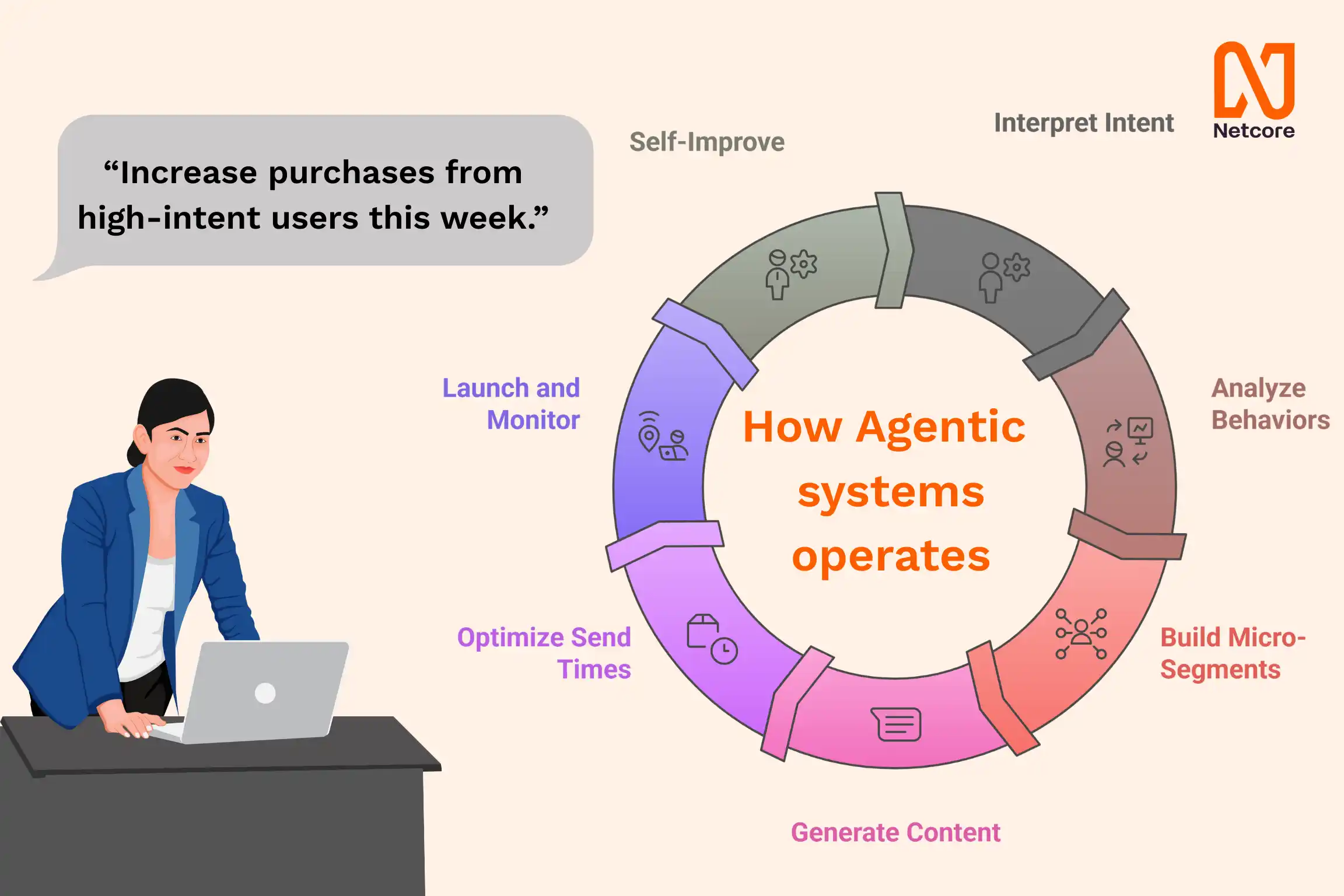
When a marketer sets a goal like:
“Increase purchases from high-intent users this week.”
Agentic systems:
- Interpret intent
- Analyze real-time behaviors
- Build the ideal micro-segments
- Generate personalized content
- Optimize send times and channel selection
- Launch and monitor all touchpoints
- Self-improve with every interaction
All autonomously. This is not rule-based automation. This is goal-based execution.
Agentic systems don’t just send messages; they optimize ROI autonomously.
Agentic Marketing vs Marketing Automation: 8 Key Differences
Here’s the truth behind the table—what these differences feel like in daily work:
| Feature | Agentic Marketing | Traditional Automation |
|---|---|---|
| Maintenance Requirements | Costs 30% less to maintain | Needs 40% more human oversight |
| Decision-making | AI decides the next-best action automatically | Humans write rules and hope they hold |
| Flexibility | Journeys adapt to behavior instantly | Journeys break when behavior changes |
| Proactiveness | AI initiates campaigns based on intent | System waits for triggers |
| Learning | Improves autonomously | Requires marketers to reprogram it |
| Personalization | 1:1 dynamic personalization for every user | 1:many static personalization |
| Optimization | Continuous, real-time | Manual, periodic, slow |
| Scale | Infinite complexity without extra headcount | More journeys = more ops and more people |
Automation pushes messages. Agentic systems deliver outcomes.
When Should You Upgrade to Agentic Marketing?
A. Signs Your Automation Stack Is Breaking
- Teams manage 50+ workflows
- Segment creation takes from days to a week.
- Campaign launch cycles exceed 3–5 days
- Retention is flat or declining, or the ideal 90:10 acquisition to retention ratio.
- You feel “blind” between reports
- Personalization is more like a wishlist than reality
If your internal ops feel bloated, it’s not your team. It’s your tools.
B. ROI Triggers for Switching
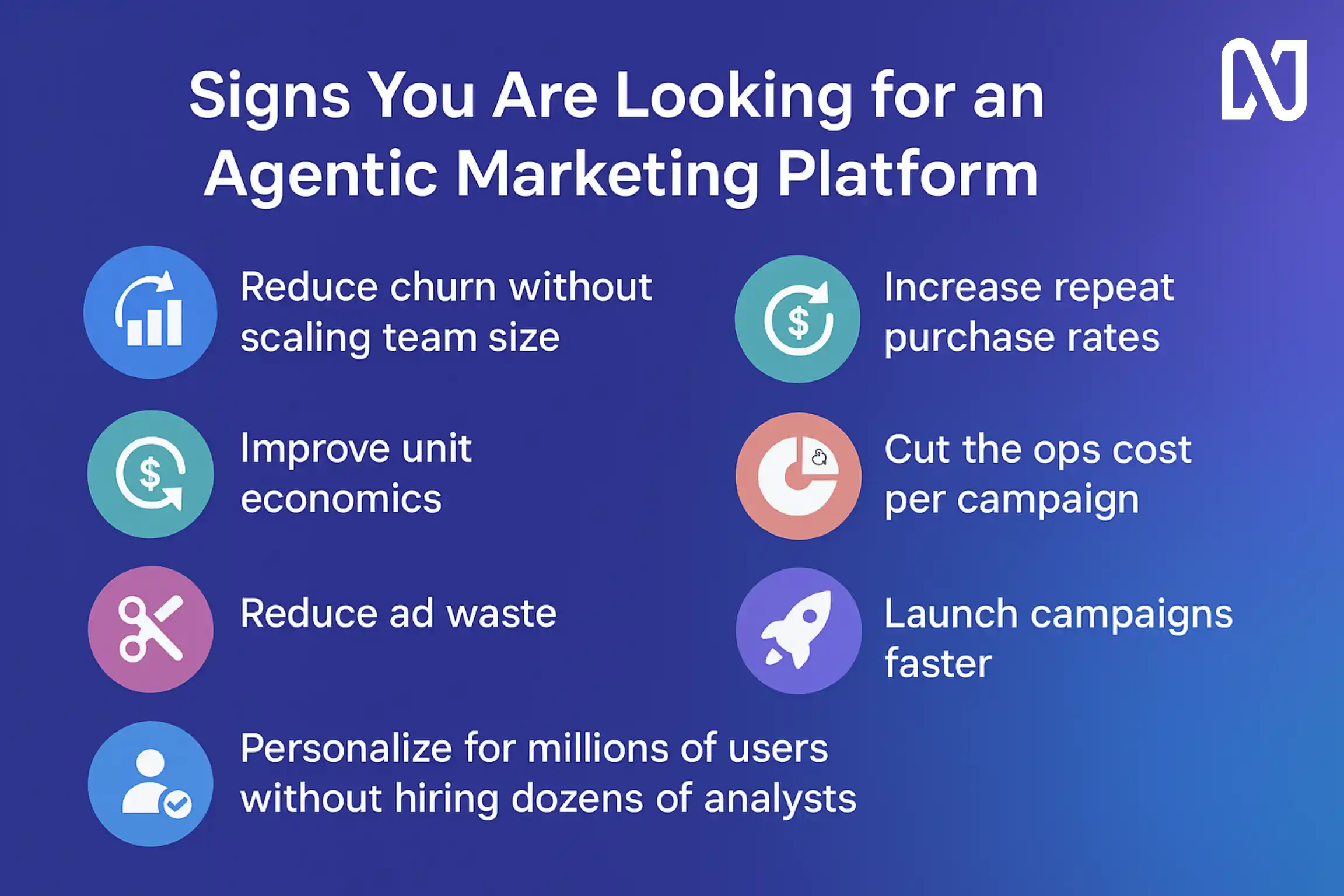
Agentic marketing pays for itself when brands want to:
- Reduce churn without scaling team size
- Increase repeat purchase rates
- Improve unit economics
- Cut the ops cost per campaign
- Reduce ad waste
- Launch campaigns faster
- Personalize for millions of users without hiring dozens of analysts
When teams feel the strain, agentic systems offer relief.
Netcore’s Agentic Marketing Platform
Agentic marketing seeks to automate and optimize the marketing process, allowing for faster and more effective communication with customers. We understand the challenges marketers face today, including the overwhelming need for personalization and the risk of bombarding customers with excessive messages.
The conversation reflects on the tension between achieving revenue growth and the tendency to focus on vanity metrics that do not drive real value.
Netcore is the first Agentic Marketing Platform where humans collaborate with specialized AI agents:
- Segment Agent builds micro-segments automatically
- Content Agent generates brand-ready creatives across channels
- Journey Agent orchestrates dynamic journeys
- Scheduler Agent picks the perfect timing and channel
- Shopping Agent powers conversational commerce
- Insights Agent identifies performance gaps and fixes them
The outcome: Campaigns that took 3–7 days to plan now take… 15 minutes. So if you are keen to make this reality for your marketing campaign, talk to us and get clarity on how you can realistically achieve this.

