
Ecommerce learnings and trends that must adopt in 2026 for revenue growth and profitability.
In 2025, ecommerce did not run out of ideas. It ran out of excuses.
Teams moved faster than ever. GenAI pilots went live. Data systems expanded. New journeys and channels were added with speed and intent. On the surface, ecommerce looked more advanced than at any point before.
But the conversation changed. As complexity grew, leadership focus shifted from possibility to payoff. CEOs and boards began asking a simpler question: what is the business case, and where is the return.
This report focuses on the points where that tension surfaced most clearly. The moments where activity was no longer enough. Where execution had to prove its impact on conversion, revenue, and profitability.
"All CFOs are now asking for what's the business case. What's the ROI?"— Schneider Electric CIO, 2025

"Are we still scaling an online business that barely pays for itself?"

"Can a serious buyer reach the right product in under a minute?"

"Who is really deciding our discounts on fresh today?"

"How many future customers will only show up if we speak their language?"

"Do we know our top missions and design differently for each one?"

"How much revenue now comes from journeys that fire themselves?"

Ecommerce economics don't change because you add more AI features. They change when you collapse dozens of bots and copilots into a small number of governed agents, sitting on unified data and explicitly accountable for online profitability.
Walmart put GenAI into search, HQ, and stores. It shipped everywhere, but online margin moved nowhere because no one owned profitability.
Customer: Occasion-based GenAI that builds full baskets.
HQ: "My Assistant" for 50K associates to summarise and draft.
Stores: AI support for 1.5M associates across tasks, policy Q&A, and 44-language translation.
Walmart learned that more copilots meant more confusion. Disconnected tools made local wins, but at scale they amplified cost and weak technical debt.
Scaling issue: Each bot had its own data view, rules, and success metric.
Hidden debt: Inconsistent answers, duplicated work, weak guardrails.
At scale: AI amplified cost and fulfilment loss, not profit.
Walmart shifted to a few governed entry agents on shared data. With clear owners, AI stopped being features and started driving profit outcomes.
Structure: Four super agents. Sparky drives shopping, Associate runs stores, Marty powers suppliers, Developer builds.
Ambition: 50% of total sales from ecommerce in five years.
AI spread across chatbots, search and copilots is activity. A few well-governed agents on unified data is strategy.
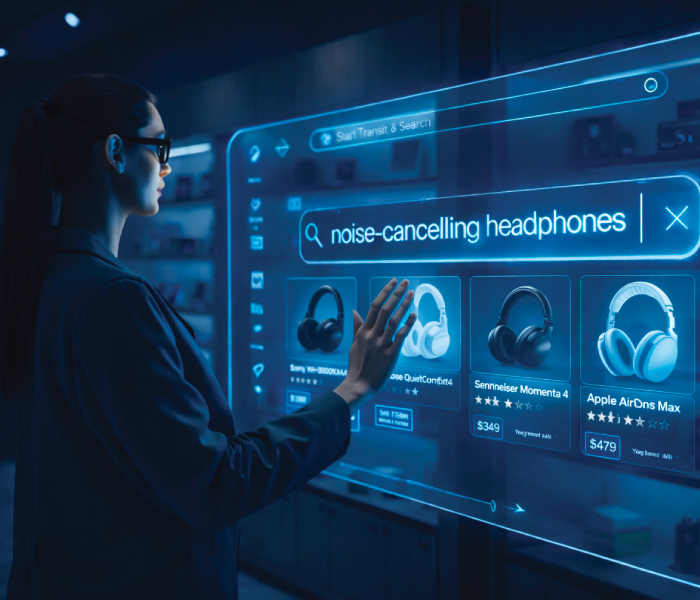
Ecommerce doesn't leak most at checkout. It leaks at search. When discovery becomes a one minute guided conversation, add to cart and revenue rise without increasing media spend.
Case in point: Restaurant Equippers, a B2B kitchen equipment retailer that turned search into a digital salesperson.
At Restaurant Equippers, buyers typed exact specs. Legacy search returned noise or dead ends, forcing tab hopping, support calls, and abandoned sessions.
Spec heavy demand: Ovens, refrigeration, prep tables with exact requirements.
Keyword limits: Weak stemming and synonyms missed trade terms.
Noisy outcomes: Precise queries still returned irrelevant options.
Restaurant Equippers adopted AI-powered search alongside Shopping Agent for guided, conversational discovery. This agent asked clarifying questions, understood specs and matched shoppers to right products instantly.
Spec understanding: Attributes, dimensions, capacity, power, trade names.
Guided flow: Clarifying questions and multi step refinement.
Shortlist speed: Confidence in under a minute, fewer wrong clicks.
Restaurant Equippers did not add new channels. Fixing discovery lifted conversion behavior and order quality by matching intent to the right SKU faster.
Add to cart: 12–20% uplift as spec-correct matches improved.
Search engagement: 3× higher with more refinement and fewer dead ends.
Revenue: ~20% uplift plus higher average order value.
If discovery takes more than 60 seconds, you're not losing attention—you're losing revenue.
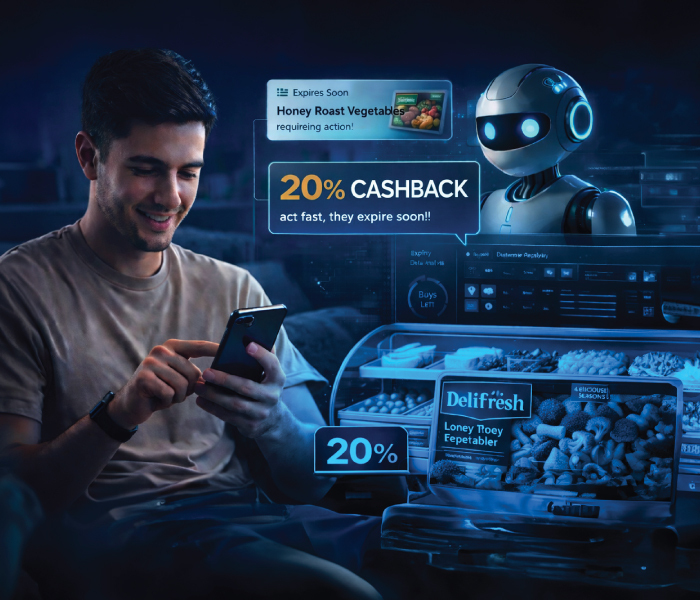
Fresh margin rarely leaks because of demand. It leaks because markdowns run on human guesswork. When markdowns become a governed, store-level AI loop, fresh turns from volatility into a controllable profit lever.
Case in point: Morrisons. A UK grocer that replaced manual markdown rounds with an AI-managed price rhythm across fresh.
Morrisons ran multiple manual markdown rounds daily. Under time pressure, teams guessed discounts store by store, and small errors scaled into big leakage.
Brand asset, daily fire drill: Fresh counters drove loyalty, but short shelf life forced constant pricing decisions.
Manual cadence: Around three markdown rounds a day, based on eyeballing stock under pressure. 3 rounds/day
Two failure modes: Too shallow meant waste. Too deep meant margin loss.
Morrisons turned markdowns into an automated loop that reads local demand, inventory, and elasticity, then updates prices through the day.
Inputs that matter: Store-level inventory, demand patterns, and price elasticity. Store-level elasticity
Continuous optimization: Prices recalculated to clear by end-of-life while protecting margin.
Action, not analytics: New prices pushed to colleagues' handhelds as guided actions.
This was not "more discounting." It was fewer manual rounds, store-specific markdown curves, and fresh economics that became predictable and scalable.
Less labour burn: Two of three daily markdown cycles removed, freeing staff time. 2 of 3 cycles removed
Local curves beat rules: Store-specific markdown trajectories replaced one-size-fits-all logic.
Cleaner outcomes: Better clearance with less margin giveaway and stronger markdown revenue quality.
Dynamic pricing on fresh is no longer experimental. It's the new baseline for grocery margin.

In growth markets, language is not localisation. It is infrastructure. When vernacular and voice become the default interface across journeys and support, you unlock both conversion lift and a lower cost-to-serve.
Case in point: Meesho treated vernacular and voice as core product rails, then used AI voice agents to scale service without scaling cost.
Meesho's core demand was Tier II+ and first-time buyers. English-first flows did not just slow checkout, they reduced trust and completion.
Base reality: 160M+ customers, majority from Tier II+ towns.
Trust barrier: English was a drop-off trigger, not inconvenience.
New-to-ecom: First-time cohorts needed confidence to transact.
Meesho rebuilt the funnel so browsing, ordering, tracking, and payment worked end to end in-language, not as partial translation for the default journey.
Scale move: Added eight vernacular languages beyond Hindi and English.
Full journey: Browse, order, track, pay in-language.
Onboarding lever: Vernacular became default onboarding for new users.
Meesho used GenAI voice to absorb high-volume queries at scale, improving resolution while cutting service cost without expanding teams for support into leverage.
At scale: ~60,000 calls per day handled by voice bot.
Efficiency: Handling time halved, ~95% resolution.
Experience: Around 10% CSAT uplift.
In growth markets, language and voice agents are not campaigns. They are the operating system for how your next 100 million customers discover, decide and get served.
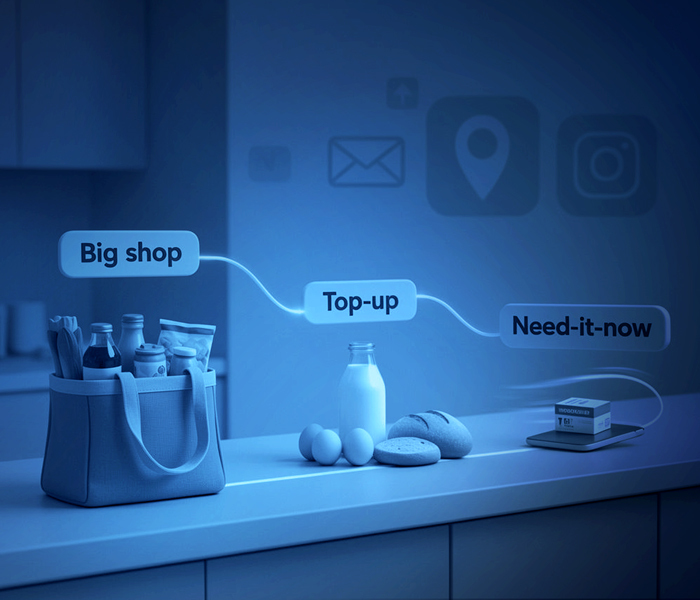
Channels are easy to report, but they hide what drives trips, baskets, and loyalty. Tesco learned that missions like big shop, top-up, and need-it-now behave like different businesses.
Case in point: Tesco reframed growth around trip missions first, then used formats like Express, online, and rapid as execution.
Tesco had formats for every trip, but decisions still defaulted to store vs online vs rapid. That blurred what customers were actually trying to do as channel-shaped.
Formats were not the problem: Superstores, Express, online, rapid were already built.
Data was not the problem: 22M+ Clubcard households map most UK shopping behaviour.
The mindset was wrong: Planning focused on touchpoints, not trip intent.
The highest-frequency trips were not big weekly baskets. They were convenience top-ups and urgent missions where loyalty is weakest and switching is easiest.
Trip mix shift: 63% of grocery trips are top-ups, not stock-ups.
Loyalty fragile: Around 50% report weak loyalty in convenience.
Rapid expands visits: Rapid users increased total visits by around 11%.
Tesco moved from channel plans to mission playbooks. It tuned assortment, pricing, and offers to trip intent, then executed via the best channel.
Organise by mission: Big shop, urban top-up, need-it-now, plus life stage.
Tune the engine: Different baskets and sensitivities per mission.
Execute by format: Express and rapid for top-ups, superstore and online for big shops.
In 2026, the serious question is not "How are our shopping touchpoints/channels performing?" – it is"What are our top missions, and how differently are we designing journeys and economics for each one?"
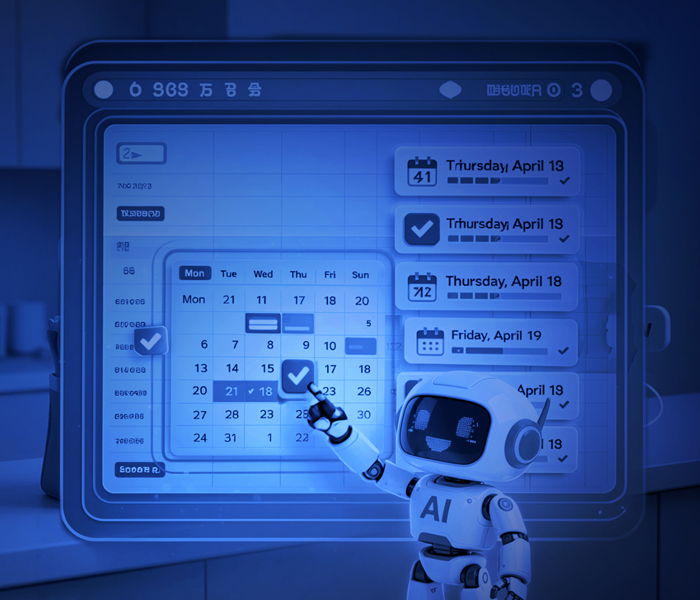
Campaigns are the loud part of ecommerce. The profit is often in the quiet moments between them.
Case in point: Fabindia proved that an AI-driven customer OS can turn live intent into triggered journeys that outperform the next big push.
Fabindia had demand and brand love, but most intent happened between campaigns where follow-up was missing and journeys quietly died.
Calendar-first engine: Peaks at festivals and launches, long unmanaged gaps after.
Broadcast habits: Email, WhatsApp, and push ran as blasts, not conversation.
Silent leakage: Browses, carts, and drop-offs rarely triggered timely follow-up.
Teams increased campaign velocity, but high-intent signals like price checks, abandons, and lapses stayed unanswered, so revenue did not compound.
Next-campaign reflex: Planning stayed calendar-led instead of signal-led.
No nudge layer: Abandons and lapses did not trigger recovery journeys.
Anonymous ignored: High-intent visitors stayed invisible until they registered.
Fabindia shifted from scheduled journeys to triggered journeys, using live behaviour to decide who to re-engage, when, and on which channel.
Live segments: Browse, cart, drop-off, return signals update instantly.
Always-on journeys: Event-triggered flows across WhatsApp, email, and push.
Impact: 2x growth in digital revenue. 9X ROI
Calendars tell you when you plan to speak. An always-on customer OS shows you whether you're listening – and how much revenue that difference is worth.
Work with our team to map agentic journeys, governance, and measurement to your P&L. A focused working session for ecommerce and retail leaders.
No sales pitch. Just a focused working session built on the insights from this report.
Share your details and we'll reach out to schedule a tailored session.
We'll respond within 24 hours with available times.