




Every major technology shift follows a familiar pattern. First, it gets dismissed as hype. Then it gets misread as an extension of what already exists. And then, often faster than incumbents expect, it rewrites the market. Agentic marketing is in that second stage right now, still being framed as smarter automation, when in reality it signals something much bigger: a break from the operating assumptions modern MarTech was built on.
Because this is not about adding more AI features to existing platforms. It is about replacing workflow-driven software with systems that can pursue goals, make decisions, and optimize outcomes autonomously. And if that shift holds, agentic marketing won’t merely improve the MarTech stack, it will begin displacing the status quo altogether.
The Category Marketing Has Been Crawling Toward for Twenty Years
Here is the uncomfortable truth about marketing automation: it is never truly automated marketing. It automated the delivery of marketing.
Segmentation, journey logic, trigger conditions, testing configurations, all still depended on humans to build, maintain, and constantly repair them as customer behavior shifted. And customer behavior now shifts faster than any manually maintained rulebook can keep pace with.
For years, the model held because marketers could anticipate enough scenarios upfront to encode decision logic manually. Then the customer changed. Faster expectations, shorter attention spans, fragmented journeys, infinite choice. The model cracked.
Three structural fractures emerged.
First, static logic does not scale with dynamic behavior. Customer intent changes in real time. Journey logic does not. Every day a rule set runs unchanged, the gap widens between the customer the campaign was built for and the customer actually receiving it.
Second, human optimization has an economic ceiling. At enterprise scale, no team can manually tune segments, update audience logic, and optimize journeys fast enough to match live behavioral signals.
Third, and most important, rules-based platforms optimize workflows, not outcomes. Rules-based platforms execute instructions. They do not reason about whether the instruction itself is still the right move.
What “Agentic Marketing” Actually Means
Much of the market is calling anything with AI “agentic marketing.” Most of it isn’t.
So, what is agentic marketing? A copilot assists. A predictive model scores. An agent acts.
That distinction changes everything.
A predictive model may tell you which customers are likely to churn. An agentic marketing platform detects that same signal, reasons across customer context, determines the best intervention, executes it across the right channel, and learns from the result, all without requiring human approval at every step.
Same data. Different operating model.
This is the maturity shift underway:
- Rules-Based Automation: Optimizes workflow efficiency
- AI-Augmented Automation: Optimizes marketer productivity
- Agentic Marketing: Optimizes business outcomes
The first two made marketers faster. The third changes what marketers do.
The Biggest Shift Since Marketing Automation Itself
When marketing automation emerged in the early 2000s, it didn’t just add capability, it changed behavior. Marketers stopped thinking in one-off campaigns and started thinking in systems.
Agentic marketing represents a shift of similar magnitude.
Except bigger.
Because this is not just about how campaigns get built. It changes what marketing teams are fundamentally responsible for.
In the automation era, marketers operated systems.
In the agentic era, marketers supervise systems defining the agentic marketing architecture.
They define goals. Set guardrails. Review outcomes. Shape strategy.
The platform becomes the operator. The marketer becomes the strategist.
That does not diminish the marketer’s role; it elevates it. Creative strategy, ethical governance, brand stewardship, business judgment: these become more important as execution burdens recede.
And this is where the technology moves from co-pilot to autopilot.
The Four Traits Defining Category Leadership
Not every vendor claiming agentic capabilities is building toward the same future. Leadership in this category will separate along four dimensions.
Specialized agents, not generic AI.
A single assistant who helps with everything is a copilot. A coordinated system of purpose-built agents is an architecture.
Domain-trained intelligence, not foundation models alone.
General models lack behavioral context. Effective agents need campaign outcomes, domain precision, and feedback loops grounded in real customer data.
Multi-agent orchestration, not single-agent automation.
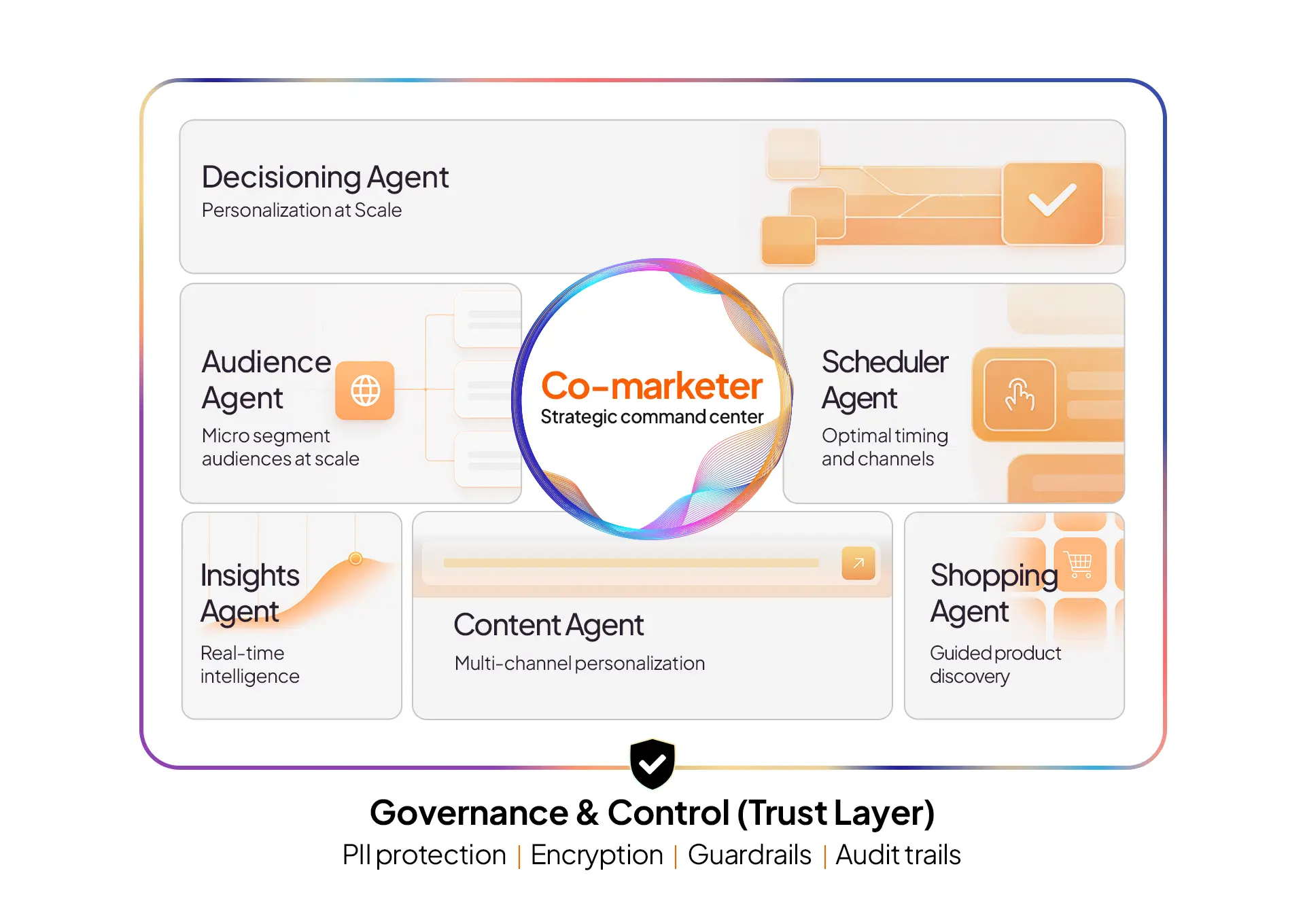
The real advantage comes when specialized agents coordinate, insights informing audiences, audiences informing content, content informing decisioning, all compounding through shared learning.
Outcome accountability, not process metrics.
Category leaders won’t be measured by opens and clicks, but by conversion lift, margin preservation, and customer lifetime value.That demands a different system, built to dominate the future of agentic marketing.
The Production Evidence Is Already Here
Category shifts reveal themselves through outcomes. And the outcomes that Netcore has presented before the world are already proving that agentic marketing is here to stay with direct revenue impact rather than just mere improvement in campaign metrics.
- Crocs reportedly achieved 7X ROAS through AI-agent-driven retention.
- Bajaj Finserv saw a 17% click lift through agentic engagement programs.
- IGP drove a 51% increase in app activations through autonomous journey orchestration.
The pattern matters more than the examples.
Across verticals, autonomous systems are beginning to outperform manually optimized workflows significantly.
Early adopters are also reporting:
- Campaign deployment up to 25x faster
- Audience segmentation 50x deeper
- Conversion rates up to 10x higher at a fraction of manual effort
These are not productivity gains. They are leveraging gains. And leverage changes markets.
How Agentic Marketing Changes Customer Experience
For customers, this is not about architecture. It is about a different kind of brand interaction.
- From relevant to anticipatory.
- From siloed channels to true omnichannel orchestration.
- From transactional interactions to conversational commerce.
- From delayed response to real-time adaptation.
The result is not just better engagement. It is a fundamentally different customer experience, one that shows up in retention, loyalty, and lifetime value.
These are not feature improvements. They are experience-level shifts.
What Makes Netcore a Category Creator for Agentic Marketing
Every major category has a company that doesn’t just participate in the shift, but defines it.
In agentic marketing, Netcore is making that claim through years of compounding investment, from early AI modelslike Raman AI in 2018 to multi-agent orchestration and the formal naming of the category at Agentic Marketing 2025. With intelligence built across messaging, commerce, and customer engagement, Netcore is not presenting agentic marketing as a feature set, but as a new operating model. And in every technology transition, the companies that define the category early often shape the terms of competition for everyone that follows.
And ahead of every other platform in this category, Netcore is already building toward two capabilities that will define the next phase of agentic marketing:
Multi-Agent Workflow where coordinated agents collaborate across complex tasks without human coordination at each step. Not one agent automating one job, but a trained team handling the full scope of a marketing objective autonomously.
Brand Twins a persistent digital representation of a brand’s voice, values, and decision-making logic, embedded into every agent as a governance model. The capability that makes autonomous marketing safe to deploy at enterprise scale, because the brand’s identity travels with every autonomous decision the system makes.
No other platform in this market is building toward both of these capabilities simultaneously.
What This Means for Every CMO Reading This
Agentic marketing is not a future state to plan for. It is a present reality beginning to separate the brands that adopt it from the brands that don’t.
The operating model shift is real:
- Marketing teams that continue manually operating campaign systems will be outrun by teams supervising autonomous ones
- Platforms optimising process metrics will be outperformed by platforms pursuing business outcomes
- Brands that personalise at segment level will be outcompeted by brands personalising at individual level, in real time, across every touchpoint
The question for every CMO is no longer whether this category exists. The question is whether your organisation is building toward it, or still optimising the last era’s architecture while the next one compounds its advantage around you. You must check out: How is the CMO role changing to Chief Profit Officer.
Category shifts don’t announce arrival dates. They reveal themselves through the widening gap between brands that moved and brands that waited.
Final Take
Every major martech category created a generation of winners and a generation of laggards. The winners weren’t always the most technically sophisticated companies. They were the ones that understood what the shift meant for the operating model, and moved before that understanding became conventional wisdom.
Agentic marketing is at that moment right now.
The architecture is real. The production results are documented. The category has been named. The creator is building capabilities that others haven’t started designing yet.
The brands that will define this era aren’t the ones still debating whether agentic marketing is a real category.
They’re the ones already inside it, setting goals, defining guardrails, and letting the system pursue outcomes they used to have to chase manually.The impossible, it turns out, was always just the next thing that hadn’t been built yet. Consult us, if you want to take your business ahead in this ever changing world of AI.